Showing posts with label photography. Show all posts

Saturday, June 30, 2012

Will the real @czardoz please stand up?


Let’s say that among my esteemed readership is a person named Bill Jones. Mr. Bill probably has one or more email addresses, but with a name as common as his, I highly doubt he managed to snag billjones@gmail.com. He probably didn’t even get billjones@hotmail.com or billjones@yahoo.com. If he were a real tech-savvy old-timer, perhaps he secured billjones@aol.com, I don’t know.

Like Bill, you are probably in the same boat. Unless you have a highly unusual name, nickname, or favorite moniker (or you’re content with using the email address provided by your regional ISP, like Cox, where the naming land grab is much less competitive), your email is probably a messy compromise bespattered with hyphens, periods, underscores, middle initials, the numeral 0 in place of the letter O (sigh), and a birth date or lucky number tacked onto the end.

Perhaps you’ve wondered what these people were like, these usurpers of the name that was rightfully yours. Perhaps you’ve wondered how they were defiling the email address that should have belonged to you. Well, short of writing them and asking, you’ll probably never know the kinds of depraved activities that your name is embroiled in.

Now let’s look at a more contemporary scenario, since email, the original social app, is no longer very social compared to Facebook, Twitter, etc. For example, there can only be one @czardoz on Twitter, and thankfully, that’s me. So imagine my disappointment when I hopped onto the Instagram train and discovered that the name “czardoz” was taken.

Not really a big deal compared to, say, human trafficking, but did it bother me? Yeah, it did. Especially since I am an avid photographer and post on Instagram fairly often, whereas I posted once on Twitter and then promptly forgot about it when neither Milla Jovovich nor Britney Spears offered a response.

But unlike email, each Instagram account comes fully loaded with a public personality that can be stalked. And what I found on faux-czardoz’s Instagram feed . . . I didn’t like it. In fact, it was fairly reprehensible stuff. If you’re the squeamish type, don’t click on the following links:

1) a girl spilling her ample cleavage onto a pool table, graced with the words “Nice Rack”
2) a dog swaddled in a Confederate flag
3) butchered pig parts, including the head
4) some guy brandishing said head in front of his face, as if to announce “I am the pig man.”

I’m not going to delve into this person’s psyche, if only because he seems like the type of bloke who would hunt me with a shotgun as soon as spit on my boots. But to make a long and unfortunate story short, I’m going to plant a warning beacon here to tell everyone that I am not this czardoz. This is the real me:


Not the pig man. Never the pig man.

Saturday, March 31, 2012

What is art? (Baby, don’t hurt me)


Recent coincidence: right around the same week that street artist Shepard Fairey was featured as a guest star on an episode of The Simpsons (“Exit Through the Kwik-E-Mart”), he also pleaded guilty to a misdemeanor charge relating to his inappropriate use (or outright theft, as some might call it) of a photograph that was the basis of his widely-seen “Obama Hope” poster.


This image is likely familiar to most people from its connection to and use during Barack Obama’s presidential campaign in 2008. Though I didn’t know his name then, I was previously familiar with Fairey’s obnoxious “Obey”stencil, which was parodied as the Homer “Dope” stencil from that same Simpsons episode.


I first became aware of this legal issue because some in the photography community were understandably up in arms over the whole idea of an “artist” basing an illustration on a photograph, but without properly crediting the photographer (that would be Mannie Garcia, a freelancer for the Associated Press). 

Also of note is the Simpsons episode itself, which I thought was one of the funnier ones in recent memory (though the Internet yet again spills bile from its contrarian spleen). The couch gag mystified me at first, because it was a parody of the opening credits sequence of the show, Game of Thrones, which I had never seen. Of course I knew it was a parody of something (over the course of 500-plus episodes, what hasn’t been parodied by The Simpsons?), and I find it amusing that here’s a show that regularly exercises its fair use rights presumably fairly, while guest star Fairey actively covered up his use of the template for his most influential work. Ironically, on the episode, Fairey plays a character on the right side of the law, busting street artist Bart Simpson, whom the establishment considers a mere “Vandal Van Gogh.” That leads to my favorite exchange from the episode:

Chief Wiggum: I don’t traffic in wordplay, Kent, but I do have a message for Mister Prank Lloyd Wright –

Lou: Uh, that’s architecture, not painting, Chief.

Chief Wiggum: They’re all artists, Lou, why don’t you open your eyes?

Indeed, I’d like to believe that different kinds of art are all equal, though I wonder what this case says about the relative value of art. Should we consider the “Obama Hope” poster a sort of collaboration between photographer Garcia and street artist/stenciler Fairey? Without the former, the latter likely would not have created the iconic work. On the other hand, one wonders if Garcia even considers himself an artist – he is after all a press photographer, at least in this instance. And it’s certainly fair to say that his photo of Obama, and the photos taken by the photographers on his left and right at the same event, their camera shutters firing within mere milliseconds of his own, would never have been seen by anyone as anything other than journalistic documents, hardly worth a glance, whereas Fairey took that and created something that affected people in a larger way. And yet, the photo did deeply affect at least one person – Fairey; otherwise he wouldn’t have been so inspired.

And finally, are we to judge the value of art by how many people are affected by it, and how deeply? Or do we acknowledge instead that the value of art is not determined by whether it inspires us, but by whether it inspires a meme? Parodies within parodies!

Wednesday, February 29, 2012

Eye of the Bewildered

When I was a child, I relished the chance to go to Balboa Park on Sundays. Sunday was the day of the street performers (these days more fashionably referred to as “buskers”). The most entertaining and memorable was a nearly legendary magician who captivated El Prado, the main drag, with his array of parlor tricks, including my favorite – tossing a playing card from ground level all the way up to a second floor veranda.

One of his lesser gags was borrowing a pair of eyeglasses from an audience member and pretending to clean them with a cloth, only to drop a small piece of clear plastic, “shocking” the crowd into thinking he had accidentally popped the lens out of the frame. I don’t remember why this was considered magical in any way, but I remember wondering if the gambit caused tiny heart attacks in the owners of the glasses. I can only hope that their vision was as bad as mine, in which case the whole mise-en-scène would have been a blur.

One day, Mr. Magic picked me and my glasses out of the crowd. Though I was delighted at being included in the performance, I was discomfited by a fact unbeknownst to him – my glasses were of a particularly shabby quality, having come from a discount optical outfit that was briefly popular back then, and consequently, one of the lenses was finicky and would come loose from the frame with the gentlest jostle. Sure enough, I watched the poor man apply his cleaning cloth to my spectacles only to find that the spectacle, indeed, was himself. My actual lens came tumbling down like the severed head of St. Paul, bouncing three times on the pavement. I imagine the first thought that ran through his mind was “Busted!” or “¡Ay, caramba!” or the like. I knew it was coming, and watched with a mixture of helpless inevitability and anxious bemusement. I could have told him not to use my glasses, but I didn’t think that it would seem convincing coming from a little kid. He may have thought I was afraid to share the spotlight, which was certainly not the case. No, he’d have to see for himself. After that, my name was mud in the busking community.

*          *          *


I was recently asked when my vision started to deteriorate, and consequently, when I started wearing glasses. It was sometime in second grade. I sat in roughly the middle row of my classroom, and, though I can’t remember whether it was a gradual or a sudden realization, at some point I ceased to be able to read what the teacher wrote on the chalkboard. (No, sissy children of the 90s, there were no whiteboards back then.)

I was further asked whether I told anyone about the problem, and I could only answer that, at the age of 7, I didn’t have the cognitive ability to discern the problem. I may have been dimly aware that the chalkboard was blurry, but as long as no one else said anything about it, how was I to know that something was awry? It didn’t occur to me to raise my hand and say, “Miss Silva, why do you look like a Monet?” And anyway, she may have taken this as a compliment.

Now that I reflect on this, I think the powers that be may have discovered my vision deficiency when I was asked to read something aloud off the board from where I sat, whereupon I had to say that I couldn’t make it out. I probably still didn’t understand it as a problem. Perhaps I took it for granted that any person in my seat wouldn’t have been able to make out the words either.

Shortly thereafter, I joined the league of bespectacled gentlepersons.

The lasting legacy of l’affaire des lunettes was how it made an awkward child feel even more awkward, especially on class picture day. As the only eyeglassed student in my class, I was the only one asked to turn my head at an angle for my photo. Apparently, either film technology or these snapshot-for-hire type school photographers were too primitive to take a flash photograph of a kid in glasses without catching glare off the eyeglass lenses.

Each year, my parents ordered a one-sheet with thumbnail-sized photos of the whole class (I think it was popular at the time, and probably even more so when my parents were of school age, to keep pictures of one’s classmates), and there I was, the only small fry among these 30-odd portraits who was gazing somewhere off to the side, into the unseen mystery. What was the alternative? I suppose I could have taken my glasses off for the photo, but no one ever asked me to, and there’s the rub.

For my begoggled brethren (and here I mean my fellow full-timers, not reading-glass dabblers or other “casual” eyeglass wearers), glasses become embedded in the way we look. They become a part of our identity in a way that people without glasses (or, “two-eyes,” as we call them) simply can’t understand. Had I doffed my glasses, I would have been able to stare straight into the camera, but I wouldn’t have been myself.

To make a comparison (and a digression): a person known for a fussy, preppy style of attire can suddenly adopt a Goth wardrobe, and people will say, my, how different he looks. Similarly, the glasses you choose represent your style and attitude, and if you have long been swaddled in the severest “German architect” frames, you can scarcely don a pair of Lennons, let alone go full Geordi, without drawing attention from acquaintances. But the analogy can go no further without strain, because there is no reasonable sartorial analogue for the glasses-wearer who switches to contact lenses or undergoes Lasik. Once glasses are a part of who you are, you look naked without them, maybe even a little alien. Sound like an exaggeration? See for yourself:

Geordi before:


Geordi after:


Shudders!

The photos above suggest to me that perhaps facial hair is a reasonable analogue to eyewear. I mean, now that we’ve had this:


. . . can we really believe that this is the same person?


Of course, facial hair is an easier fix than myopia, and it doesn’t apply to the distaff population (circus folk notwithstanding). More to the point, though, neither clothing nor facial hair creates a literal and metaphorical barrier of perception between the person and the world. Though clothing is a barrier, it doesn’t compare because we all wear clothes in public. As for a beard, it hides at most your mouth, which is merely the window to your stomach, not the window to your soul. (Unless you’re Homer Simpson, in which case your stomach is your soul.)

Perhaps I overestimate this barrier of perception as a thing that distorts the way people see me.  In reality, the person most affected by the barrier is not the one looking at the lenses, but the one looking out through them. It’s not only that people see the glasses before they can get to you; you, too, only see the world through a filter. It may be the clearest, most polished and happily anti-reflective filter in the world, but it’s still a kind of wall that reminds you of some defect in yourself that necessitated corrective measures.

People can see me with or without the glasses, and it probably doesn’t make a critical difference to them. But I never see myself as the person without glasses, for the very simple reason that I can’t. My eyes aren’t good enough. There is no point in looking at the mirror without my glasses on because I’d have to put my face three inches from it just to see my reflection clearly, and this rather defeats the purpose of trying to see myself in a normal way and as a normal person without glasses. As far as I can tell, without glasses, I am an alien, if only from myself.

So shall I say, once a glassman, always a glassman? I could wax poetic about the charm of seeing the world out of focus when I wake up in the morning, but that would be like extolling the virtues of the music of the deaf. And I wonder what it feels like to be Geordi after, seeing the world the normal way, without a machine in between. I can’t remember what that was like.

Whether the vision is perfect or flawed, it does seem like there is something authentic about taking the glasses off. Maybe this is because, as a child, I learned everything I needed to know from Star Wars, and one of the lessons is that the mask has to come off for Darth Vader to become Anakin again:

Just for once, let me look on you with my own eyes. – Darth Vader

Wednesday, November 30, 2011

The Gateway City

For being such a well-known place and such an old city (by American standards), St. Louis is actually a relatively small city.  St. Louis is home to Anheuser-Busch of Budweiser fame; it hosted, in the same year, a World’s Fair and an Olympic Games (1904 – the first Olympics in the United States); the Cardinals are a storied baseball team.  Most of us are familiar with Charles Lindbergh’s Spirit of St. Louis and the film Meet Me in St. Louis.  St. Louis has most of the things that seem to characterize a cosmopolitan city: museums, trendy restaurants, nightlife, a large urban park, a symphony orchestra, a passable light rail system, an international airport, a well regarded research university, three major sports teams, and at least one iconic feature: the Gateway Arch.  Yet as I drove around town on a recent visit, seeing various neighborhoods, and trying to figure out what made this place special, it was hard to escape the feeling that there wasn’t much going on.  It felt like a smaller version of a city like Chicago, or even San Diego.  It was sort of a Portland of the Midwest, though less hipsterific.  But it’s hard to distinguish yourself by being a smaller version of something else.  As Emerson wrote in the Divinity School Address,

Imitation cannot go above its model.  The imitator dooms himself to hopeless mediocrity.  The inventor did it, because it was natural to him, and so in him it has a charm.  In the imitator, something else is natural, and he bereaves himself of his own beauty, to come short of another man’s.

*          *          *

Gateway Arch, designed by Eero Saarinen.  The one thing everyone knows about St. Louis, this symbol is ubiquitous in the city, found in souvenir photos and knickknacks, integrated into logos, and even used as a replacement for the “N” in some signs.
   
A placid scene from the Occupy St. Louis presence downtown, in the shadow of the Arch and the Old Courthouse.

Washington Avenue with the lights on.  The locus of nightlife downtown.

The original office building at the Anheuser-Busch brewery.  I’ll never forget the smell that saturated the air around the complex, richly earthy and almost appetizing.  Malted barley, maybe?  Yeast?  I don’t know, but I like it.

Inside the City Museum, something like a funhouse crossed with a wrecking yard, but nothing like a museum.

Rue Lafayette, a cafĂ© cum antiques and vintage goods store.  Note the A. E. Housman poem, “With Rue My Heart is Laden,” framed.  Is there a pun there?

What we know as Panera Bread actually started in St. Louis under a more local moniker.  (No, I didn’t go inside for a snack, although on my first visit to St. Louis, some seven years ago, I did go to this very one, and thought, "This food is good.  They should really expand nationally."  I guess they went with that.)

I found religion when I tried the gooey butter cake, one of the triumvirate of uniquely St. Louis delicacies (the other two being toasted ravioli and St. Louis-style pizza).  It tasted like a moist brownie, but not chocolate.  Or something like the widely available raspberry bars or toffee almond bars, but . . . gooey-er.  Like manna, my friends.  I'm talkin' Old Testament.

Toasted ravioli.  I felt very much that this is the right way to prepare ravioli.  I don’t dislike your typical boiled ravioli with sauce, but I don’t think I’ve ever thought to myself, “I really have a hankering for some ravioli today!”  And I’ve always thought it kind of silly when upscale restaurants have some version of ravioli on the entrĂ©e menu, whether something exotic like rabbit or elk (no matter how outlandish the animal, you never get any discernable flavor from the ground meat paste that goes inside the dough), or a token vegetarian option.  But when I tried the toasted ravioli, I thought, “Yes, this is something I could find myself craving.”  Perhaps, alongside the Arch, the home-grown cuisine can truly be considered the pride of St. Louis.

*          *          *

St. Louis compares favorably with another medium-sized Midwestern city I’ve visited: Cleveland.  That probably doesn’t sound like a recommendation, but both of these cities have beauty to find, and I’ve enjoyed my chances to visit less obviously enchanting places.  When you go to New York, if you’re a certain sort of savvy traveler, you try to look for “off the beaten path” attractions and “neighborhood joints,” and you marvel at your good luck and ingenuity when you capture a taste of what the “locals” do, as opposed to getting mired in tourist traps.  But when you visit a place like St. Louis, it’s pretty much all “off the beaten path,” and it allows you to appreciate discovering a place without the mist of preconception between you and it. 

My only regret upon leaving the Gateway City was that I didn’t try the St. Louis-style pizza, which is distinguished by the thin and crispy crust and the trademarked Provel cheese, a kind of processed cheese that I have heard will “stick to your mouth” and is “kind of gross.”  Apparently, this oddity can only be found in St. Louis and the environs, and the locals seem to either love it or hate it.  Maybe some even love to hate it, which is as strong a recommendation as I can think of for trying it. 
              
Next time, St. Lou.  Next time . . .

Tuesday, May 31, 2011

Gotta Catch His Ball!


Though the above photograph is about as blurry and confused as a Psyduck, the viewer should be able to discern the unmistakable image of a tiny boy dressed in what could only be interpreted as an Ash Ketchum costume, with a canary yellow balloon trailing behind him as a fanciful representation of Pikachu. Look carefully. See the red and white hat peeking out from behind the bus door. See the blue backpack and blue shoes, the overall air of shrimpy insolence. Revolting, isn’t it? This may not be a perfectly accoutered Ash (see below), but the imagination involved makes it stand out from mere verisimilitude.

I stalked this mother and child parade for about the length of a street block, trying to capture the money shot while eluding their notice. Astonishingly, the sight of a grown man bounding after a little runt and snapping pictures has the tendency to cause ignorant passersby to mistake said man for a child snatcher. My aversion to being featured on yet another episode of To Catch a Predator forced me to take a timidly defensive posture, like, I don’t know, a Metapod? (He only knows how to “harden,” hahahaha! Disgusting.) Shackled as I was by our suspicious American culture, this photo, shot with my ancient Nokia cell phone’s 2-megapixel camera from a great distance, obscured and fuzzy as it is, was the best and only one I could get.

As the old adage goes, the best camera is the one you have with you. I would have liked to have been wielding my Pentax DSLR with a super-telephoto lens attached at the moment that I stumbled on the lad. But, like a PokĂ©mon trainer who comes upon a rare PokĂ©mon but has no master ball . . . uh . . . and then he has to use his other ball . . . um . . . and his type is weak against some other type . . . er . . . I’m not good with these PokĂ©-nalogies.

What other franchise could I try . . .

Like Elliot Salem and Tyson Rios bro-ing it up in Army of Two, you use the tools you have. If you don’t have a guitar to celebrate surviving a hairy back-to-front tandem parachuting gauntlet, you muscle out some air guitar and make funny noises with your mouth. Don’t have a girl to hug after dishing out a nasty decap? Just walk up slowly behind your partner, grip him tenderly but snugly around the waist (back to front, natch), and lift him gently off the ground until you can feel his manly weight upon you. Then lower him like a child cradled in your loins, his warmth commingling with yours. And hush, no words now, lest you disturb the sanctity of this moment.

Ugh, what depravity. I guess pedophilia is still worse, right? Right???

Thursday, October 14, 2010

San Diego in Pictures

Is it redundant to promote oneself within one’s own blog? Please take a look at my photographs of San Diego at the Life Panoramic website.

Note: I am not trying to unduly impress anyone or suggest that I won some kind of competition. As far as I can tell, there was no extensive selection process before my photographs were published. In fact, all I did was submit my photos, and the next day, I noticed they were up on the site. I was never contacted by the site. For what it’s worth, I think my photos are pretty good, and I think this website has an admirable goal, which is to have people document the places they live in.

Sunday, August 8, 2010

Long live the Con!

Who says you have to get inside Comic-Con to have a good time? Here’s what I saw on the outside looking out, walking around in front of the Convention Center and strolling the Gaslamp.

The Milieu

For a few blissful days every summer, Comic-Con turns the Gaslamp District into a veritable tent city of Amazons, Voltrons, Superfriends, orcs, wizards (both pinball and Hogwartian), spiky-haired Japanophiles, Sailor Scouts (yes, they still exist), keyblade-slingers, Pokemon trainers, X-Maniacs, Jedi Knights and other sad devotees of ancient religions – all wearing matching lanyards and packing grossly oversized swag bags.

* * *

The San Diego Convention Center, home of Comic-Con, has fitful dreams, talks in its sleep: “Must . . . grow . . . bigger! Accommodate . . . more . . . vendors! Keep . . . the Con . . . local!”

* * *

Comic-Con is the one event that makes downtown San Diego feel like the hub of a city that is more than a zoo and some beaches. And somehow, it does this by transforming skyscrapers into gargantuan video game posters.

* * *

Yes, more posters!

* * *

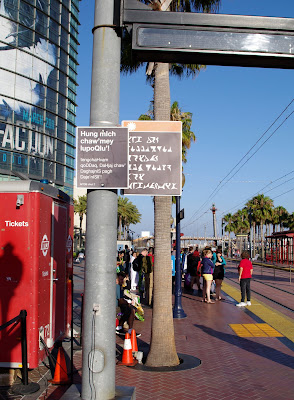
Trolley signs in Klingon = a brilliancy! True or False: Klingons hail from the planet Klingonigon!

* * *

It turns out that Skyline is a movie about people floating up into the sky, hence the little white bubble-men in this frame.

* * *

Yeah! Bubble-Man!

* * *
The Denizens

Don’t bears already have enough of an advantage without toting machine-guns as well?

* * *

Now hold the phone there, Michael Eisner. Something’s not quite right about these Disney princesses. I mean, come on, where’s Tiana???
* * *

Mob scene: a crowd hoping to catch Dragon Age 2 blow-up spears tossed from a balcony. Seriously.

* * *

Now isn’t that adorable? It’s a Wonder . . . boy . . . bun . . .?

* * *

Girl with platinum hair and rabbit ears. Now that’s what I’m talking about!

* * *

Before all those bad dreams started, Freddy Krueger was just another carefree kid reading Dick Tracy and kicking it with a Milhouse.

* * *

Ah, the classic “girl being ogled by sleazy dudes” photo. A timeless set piece.

* * *

Hahaha, some of you will get this joke. You perverts know who you are.

* * *

Will someone please give her a cookie, a tiara, and a box full of gold stars?

* * *
Walking among this elbow-to-elbow mess of exuberant humanity, and having cosplayed once myself, I was happy to see how many people had donned costumes (both homemade and store-bought), painted themselves, built accessories, stretched their imaginations to come up with something unfamiliar, and posed proudly for photos.

And then I became convinced of something. These wizards’ robes, metal brassieres, horns, lightsabers, princess gowns, all manner of animal furs – these were not the costumes. These represent something real about what these people care about. No, the costume is that fashion-challenged, mother-approved school attire that these chaperoned kids go back to when Comic-Con ends. The costume is that ill-fitting work shirt and suffocating necktie that the guy in the head-to-toe Vader outfit returns to after he takes his bag of newly bought action figures home.

The costume is that attitude we put on that says we’re okay with the life of workaday monotony, where we have to act like we don’t really know all that much about the things we value most, where we pretend that, yes, those are just little hobbies that we have, those comics, those games, those movie trailers that we wait hungrily for, or maybe it’s music or dancing or poetry or even Latin grammar, mirabile dictu! This is the stuff that makes people distinctive, and it’s the stuff they do when they are being who they want to be.