Thursday, May 24, 2012

@czardoz


If this blog were a Twitter feed:

Why does “permission to speak frankly” always mean permission to tell you what an incompetent fool you are? #permissiondenied

And why would such permission ever be granted?!? #justdontgetit

Thank you TV execs for canceling Ringer and Pan Am. Once again, you prove that you don’t know your asses from your faces. #subtledifferences

If I were going to start an Asian boy band, I’d name it Boyster Sauce. #notracistjustracial

Logged into MySpace for the first time in years, noticed they now offer the option of logging in with your Facebook account. #Tomcanceledhisaccount

Man, got hot today. Makes me mad when it gets hot all of a sudden. #makesmemad

Gay guy estimated that I was “18% gay.” Should I be insulted that it’s so high, or insulted that it’s so low? #justbecauseIlikeGuyPearce

Just saw a bumper sticker that read “Obummer.” As they say, the simplest is most profound. #obamanations

New Bond movie coming. Gotta admit the only scene I remember from the first D-Craig film was the ball-breaker torture chair. #testytestes

Guy named Weiner forced to resign because he sexted pics of his wiener? Should’ve received a Pulitzer for living the pun. #livebythesword

Had a dream last night that all these tweets were really just Facebook status updates. #mindblown

Like, dude, is this my ass or is this my face? I don’t even know!!! #the1percent

Sunday, May 20, 2012

You had me at "festooned"


“F” is the funniest letter that you’ll ever do. Don’t believe me? Then why are the funniest words all “F” words? For example:

  • festooned
  • funicular
  • floozy
  • flummox
  • farrago
  • flabbergasted


Need more evidence of the funnies? All right, why do so many “F” words refer to fools and their foolishness? Here are just a few:

  • folderol
  • flapdoodle
  • fiddle-faddle
  • frippery
  • foofaraw
  • flimflam
  • fop
  • flibbertigibbet


From the medical community comes “flatulence.”

The culinary community gives us “frankfurter” and “falafel.”

The silliest perversion to be worthy of headlining an episode of Law and Order: SVU? No, it isn’t fire fetishism (though that’s close). It’s “frotteurism,” also known by the more poetic name of “frottage.”

And I know it’s not primarily English, but you have to admit that “fatwa” is a pretty funny word.

Still not convinced? Then answer me this: who is the funniest, fattest fellow in Shakespeare? Falstaff. That’s three “F”s! 

I rest my face.

Friday, April 20, 2012

Who are you to live in all these many forms?


About thirteen years ago, I walked into the Max Palevsky Cinema at Ida Noyes Hall at the University of Chicago with my season pass to Doc Films in hand, fully intending and somewhat eager to watch The Thin Red Line, Terrence Malick’s war movie that had been released early in 1999 (officially in limited release in 1998, to be eligible for the Oscars). The movie is notable for being the “other” war movie of the year, released to far less fanfare than Steven Spielberg’s Saving Private Ryan. The Thin Red Line also features almost every male movie star you’ve ever heard of (George Clooney, John Travolta, John Cusack, Woody Harrelson, Adrien Brody, even Jared Leto. Even Thomas “The Punisher” Jane!), most of them in roles lasting between ten seconds and a couple of minutes (this in a nearly three-hour-long film).

As a young cinéaste brimming with culture and mindful of the accent aigu, I looked forward to comparing the two WWII epics, and settled into my seat for what felt like an unusually long wait. Grumblings in the seats gave way to frail resignation when the powers that be at Doc Films eventually deigned to inform the audience that technical difficulties would deprive us of a film this evening. What would I do now? Head home and not download the movie through the BitTorrent technology that did not exist at the time? Obviously, that’s exactly what I did (or, what I did not do?).

The years passed by. I directed a couple of films for my dorm’s annual film fest, while Malick released a couple more films starring Colin Farrell and Brad Pitt; our respective achievements being roughly equal in distinction, I’d say. But in all the time since that abortive attempt in college, I never got around to watching The Thin Red Line. And so when the film was recently made available to me in a free, non-torrent-related way, I decided to watch it. Thirteen years later, I would have my revenge. (“Revenge?” you may ask. “Revenge on what?” I don’t know, maybe nothing. Maybe I just wanted to say, “I would have my revenge.”)

Having seen Malick’s patience-trying The Tree of Life last year, with memories of it still painfully fresh, I had a good idea of what to expect from my mercurial, well-documented compeer in the cinematic arts. The Thin Red Line is certainly epic, in the sense of having immense visual scale and ambition. It is burgeoning with emotion and includes what must be every variant of anguished facial expression.

Malick indulges his fetish for what I might call “voiceover,” but which is probably more accurately a series of disembodied prayers or spoken dreams that just happen to coincide with images of what must be the most eloquent soldiers of all time.

Nature and man exchange moments of preeminence, the former unambiguously holy, the latter a cauldron of self-doubt and self-destruction, always taking for granted the primacy of the self, for better or (usually) worse.

Much like Jessica Chastain in The Tree of Life, Miranda Otto plays the role of salvific beauty, a memory both literally and figuratively “washed,” a singular image of domesticity amid war and nature. She is gorgeously photographed, awash in lens flares and ethereal lighting.

A first-rate composer (Hans Zimmer) is brought on board to contribute first-rate work, which is then soundly overshadowed by glorious selections of classical music.

Plot doesn’t much matter. In fact, I initially thought the setting was Vietnam, until I heard a character utter the word, “Japs.” But Vietnam, Korea, WWII, Wolf 359, it doesn’t matter because the movie doesn’t take its meaning from the story and dynamics of those conflicts. Rather, it strips away the social consciousness of specific historical incidents in favor of a philosophical meditation on the relationship between soldiers and war itself, and the conflict that war creates within the individual.

That, in a few paragraphs, seems to sum up what makes a Terrence Malick movie.

So how does The Thin Red Line compare to Saving Private Ryan? Well, in homage to Tom Hanks’s parting words to Matt Damon in the latter, I still delight in playing co-op war video games with my brother and uttering, “Earn this!” every time I sacrifice myself to save him. But beyond this and a general appreciation of Saving Private Ryan as a great entertainment, worthy of all manner of movie critic blather (“tour de force,” anyone?) I don’t know that it is as memorable as The Thin Red Line will be for me, and as The Tree of Life has been. Saving Private Ryan takes a conventional view of morality and pursues it through a familiar cinematic language and aesthetic. It does many things right because it plays within a sandbox of established standards. In contrast, The Thin Red Line is in some sense beyond good and evil. It seems to try to create its own standards of aesthetics and morality.

Having said that, there are perhaps viewers who enjoy “difficult” movies simply for the sake of their being challenging and different; I am not such a viewer. For all the beautiful poetry that The Thin Red Line creates (and the same is true for The Tree of Life), for all the philosophy it refracts, it is a supremely contemplative movie, more like a vision quest than an entertainment. It could fairly be called tedious or self-indulgent, but at its best, it feels like more than a movie.

I might compare it to going out to the desert and staring at the sky and the mountains for a few hours, and then a snake slithers past your feet and a dying man-child whispers inscrutably into your ear, “Are you righteous? Kind? Does your confidence lie in this? Are you loved by all? Know that I was, too. Do you imagine your suffering will be any less because you loved goodness, truth?” Yeah, it’s pretty much the opposite of going to Disneyland.

Certainly, it wasn’t important enough to me at the time to hunt out some other way of watching the movie. But it’s funny to think how one accident of fate led to a thirteen-year delay. I wonder if it would have changed the course of my life in any way had I seen it that night, when I had intended to. Dare I ask, in emulation of Sliding Doors (a movie I actually did watch in college), what happened in that other timeline?

Maybe I would have been inspired to create a completely different life. Instead of graduating from college, I make my own vision quest into the jungles of South America. Instead of working a day job, I contemplate the futility of civilized society while foraging for berries. Instead of learning to ballroom dance, I swim in lakes with indigenous children. Instead of taking photographs, I am the photograph. Leaves are my toilet paper, and the world is my toilet. One day, my child bride scrapes her knee, and I blow on the wound, my breath unwittingly setting off a course of weather events that will culminate in the hurricane of the century thousands of miles away that wipes out the New England coast, enveloping Harvard student Mark Zuckerberg in its wake. Facebook never exists!

Instead of wasting the best years of his life mired in the death spiral of browsing mundane status updates and “poking” his “friends,” a UChicago grad student in the Committee on Social Thought remains motivated enough to build the world’s first time machine; materials include pointed critique, snarky retorts, and the guarded praise bestowed by an emeritus professor. He travels back in time to one evening at Doc Films, where years ago he waited in vain to watch The Thin Red Line, thereafter always wondering what would have happened in the alternate timeline where he actually does watch it. He repairs the malfunctioning projector, and this time, the audience watches the movie in full, rather than heading home to open Netscape Navigator to see if Amazon has finally opened a VHS store.

Somewhere in the audience, I am rapt by an image on screen of the sunlight glimmering through the jungle canopy, and am boggled by the possibility of loving and hating a movie at the same time. This cocktail of emotions compels me to consider the fundamental role that discontentment plays in motivating human beings toward something greater than ourselves. I unleash ramblings to this effect upon the nearest willing soul, who happens to be a toothsome first-year with a bonnet full of AP credits and a weakness for rambling men. Philosophical discourse leads to sweet nothings and mad caresses, and I find myself an intoxicated man in the bloom of new love; then a relationship man, expected to provide the emotional responsiveness that underpins all human closeness, and yet is ever elusive; then a man divided against himself, my devotion to the beauty of a crumbling reality at war with my devotion to the beauty of childish hopes; then finally, a shattered man, finding peace nowhere, able to neither serve nor command, most alone when in society, and wondering, always wondering what might have happened if only that blasted projector had malfunctioned that fateful night, and I had to leave the theater without watching that accursed film. I start muttering in my sleep, choking the words out upon my pillow, “Mother Jungle, cradle me in your bosom.” My toothsome lass tells me, “If you love the jungle so much, why don’t you crawl back up its womb?”

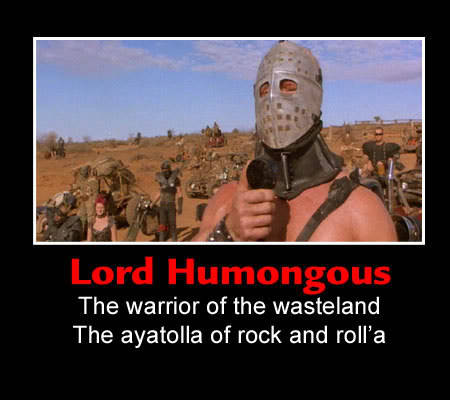
And so I do. I sell all my earthly possessions to buy the autogyro from The Road Warrior, and I fly south to a new world, in search of new life and no civilization, desperate to become just a man. On the way, I am set upon by jealous bandits and thugs led by a brutish yet strangely articulate madman named The Humungus. They fire upon me, disabling my craft. I crash land in Belize, but narrowly survive and am nursed back to health by a pack of stoic spider monkeys. When I have fully healed, I am integrated into their simian society, and eventually earn my monkey name by saving the life of the sanctified monkey chieftain from the jaws of a wicked jaguar, the curiously named Jagar. In gratitude, he offers me his daughter Poalipalina in marriage. I decline, because even for a man who has turned his back on human society, the idea of marrying a monkey is pretty disgusting. This rejection fills Poalipalina with shame and self-loathing; after all, what monkey would want her now? Distraught, she commits ritual suicide by plunging into the Chasm of Scorned Ambitions and dashing herself to pieces upon the rocky feet of the Many-Fingered River God (who is really just a waterfall). The monkey chieftain claims that I have disgraced his tribe and cries out for blood, vowing that he will have his revenge. His warriors don the armor of the aggrieved and hunt me with the slings of the affronted. I flee for my life and vine-swing through the wilderness until I reach the jungles of South America, thus creating the timeline you have just witnessed.

Saturday, March 31, 2012

What is art? (Baby, don’t hurt me)


Recent coincidence: right around the same week that street artist Shepard Fairey was featured as a guest star on an episode of The Simpsons (“Exit Through the Kwik-E-Mart”), he also pleaded guilty to a misdemeanor charge relating to his inappropriate use (or outright theft, as some might call it) of a photograph that was the basis of his widely-seen “Obama Hope” poster.


This image is likely familiar to most people from its connection to and use during Barack Obama’s presidential campaign in 2008. Though I didn’t know his name then, I was previously familiar with Fairey’s obnoxious “Obey”stencil, which was parodied as the Homer “Dope” stencil from that same Simpsons episode.


I first became aware of this legal issue because some in the photography community were understandably up in arms over the whole idea of an “artist” basing an illustration on a photograph, but without properly crediting the photographer (that would be Mannie Garcia, a freelancer for the Associated Press). 

Also of note is the Simpsons episode itself, which I thought was one of the funnier ones in recent memory (though the Internet yet again spills bile from its contrarian spleen). The couch gag mystified me at first, because it was a parody of the opening credits sequence of the show, Game of Thrones, which I had never seen. Of course I knew it was a parody of something (over the course of 500-plus episodes, what hasn’t been parodied by The Simpsons?), and I find it amusing that here’s a show that regularly exercises its fair use rights presumably fairly, while guest star Fairey actively covered up his use of the template for his most influential work. Ironically, on the episode, Fairey plays a character on the right side of the law, busting street artist Bart Simpson, whom the establishment considers a mere “Vandal Van Gogh.” That leads to my favorite exchange from the episode:

Chief Wiggum: I don’t traffic in wordplay, Kent, but I do have a message for Mister Prank Lloyd Wright –

Lou: Uh, that’s architecture, not painting, Chief.

Chief Wiggum: They’re all artists, Lou, why don’t you open your eyes?

Indeed, I’d like to believe that different kinds of art are all equal, though I wonder what this case says about the relative value of art. Should we consider the “Obama Hope” poster a sort of collaboration between photographer Garcia and street artist/stenciler Fairey? Without the former, the latter likely would not have created the iconic work. On the other hand, one wonders if Garcia even considers himself an artist – he is after all a press photographer, at least in this instance. And it’s certainly fair to say that his photo of Obama, and the photos taken by the photographers on his left and right at the same event, their camera shutters firing within mere milliseconds of his own, would never have been seen by anyone as anything other than journalistic documents, hardly worth a glance, whereas Fairey took that and created something that affected people in a larger way. And yet, the photo did deeply affect at least one person – Fairey; otherwise he wouldn’t have been so inspired.

And finally, are we to judge the value of art by how many people are affected by it, and how deeply? Or do we acknowledge instead that the value of art is not determined by whether it inspires us, but by whether it inspires a meme? Parodies within parodies!

Wednesday, February 29, 2012

Eye of the Bewildered

When I was a child, I relished the chance to go to Balboa Park on Sundays. Sunday was the day of the street performers (these days more fashionably referred to as “buskers”). The most entertaining and memorable was a nearly legendary magician who captivated El Prado, the main drag, with his array of parlor tricks, including my favorite – tossing a playing card from ground level all the way up to a second floor veranda.

One of his lesser gags was borrowing a pair of eyeglasses from an audience member and pretending to clean them with a cloth, only to drop a small piece of clear plastic, “shocking” the crowd into thinking he had accidentally popped the lens out of the frame. I don’t remember why this was considered magical in any way, but I remember wondering if the gambit caused tiny heart attacks in the owners of the glasses. I can only hope that their vision was as bad as mine, in which case the whole mise-en-scène would have been a blur.

One day, Mr. Magic picked me and my glasses out of the crowd. Though I was delighted at being included in the performance, I was discomfited by a fact unbeknownst to him – my glasses were of a particularly shabby quality, having come from a discount optical outfit that was briefly popular back then, and consequently, one of the lenses was finicky and would come loose from the frame with the gentlest jostle. Sure enough, I watched the poor man apply his cleaning cloth to my spectacles only to find that the spectacle, indeed, was himself. My actual lens came tumbling down like the severed head of St. Paul, bouncing three times on the pavement. I imagine the first thought that ran through his mind was “Busted!” or “¡Ay, caramba!” or the like. I knew it was coming, and watched with a mixture of helpless inevitability and anxious bemusement. I could have told him not to use my glasses, but I didn’t think that it would seem convincing coming from a little kid. He may have thought I was afraid to share the spotlight, which was certainly not the case. No, he’d have to see for himself. After that, my name was mud in the busking community.

*          *          *


I was recently asked when my vision started to deteriorate, and consequently, when I started wearing glasses. It was sometime in second grade. I sat in roughly the middle row of my classroom, and, though I can’t remember whether it was a gradual or a sudden realization, at some point I ceased to be able to read what the teacher wrote on the chalkboard. (No, sissy children of the 90s, there were no whiteboards back then.)

I was further asked whether I told anyone about the problem, and I could only answer that, at the age of 7, I didn’t have the cognitive ability to discern the problem. I may have been dimly aware that the chalkboard was blurry, but as long as no one else said anything about it, how was I to know that something was awry? It didn’t occur to me to raise my hand and say, “Miss Silva, why do you look like a Monet?” And anyway, she may have taken this as a compliment.

Now that I reflect on this, I think the powers that be may have discovered my vision deficiency when I was asked to read something aloud off the board from where I sat, whereupon I had to say that I couldn’t make it out. I probably still didn’t understand it as a problem. Perhaps I took it for granted that any person in my seat wouldn’t have been able to make out the words either.

Shortly thereafter, I joined the league of bespectacled gentlepersons.

The lasting legacy of l’affaire des lunettes was how it made an awkward child feel even more awkward, especially on class picture day. As the only eyeglassed student in my class, I was the only one asked to turn my head at an angle for my photo. Apparently, either film technology or these snapshot-for-hire type school photographers were too primitive to take a flash photograph of a kid in glasses without catching glare off the eyeglass lenses.

Each year, my parents ordered a one-sheet with thumbnail-sized photos of the whole class (I think it was popular at the time, and probably even more so when my parents were of school age, to keep pictures of one’s classmates), and there I was, the only small fry among these 30-odd portraits who was gazing somewhere off to the side, into the unseen mystery. What was the alternative? I suppose I could have taken my glasses off for the photo, but no one ever asked me to, and there’s the rub.

For my begoggled brethren (and here I mean my fellow full-timers, not reading-glass dabblers or other “casual” eyeglass wearers), glasses become embedded in the way we look. They become a part of our identity in a way that people without glasses (or, “two-eyes,” as we call them) simply can’t understand. Had I doffed my glasses, I would have been able to stare straight into the camera, but I wouldn’t have been myself.

To make a comparison (and a digression): a person known for a fussy, preppy style of attire can suddenly adopt a Goth wardrobe, and people will say, my, how different he looks. Similarly, the glasses you choose represent your style and attitude, and if you have long been swaddled in the severest “German architect” frames, you can scarcely don a pair of Lennons, let alone go full Geordi, without drawing attention from acquaintances. But the analogy can go no further without strain, because there is no reasonable sartorial analogue for the glasses-wearer who switches to contact lenses or undergoes Lasik. Once glasses are a part of who you are, you look naked without them, maybe even a little alien. Sound like an exaggeration? See for yourself:

Geordi before:


Geordi after:


Shudders!

The photos above suggest to me that perhaps facial hair is a reasonable analogue to eyewear. I mean, now that we’ve had this:


. . . can we really believe that this is the same person?


Of course, facial hair is an easier fix than myopia, and it doesn’t apply to the distaff population (circus folk notwithstanding). More to the point, though, neither clothing nor facial hair creates a literal and metaphorical barrier of perception between the person and the world. Though clothing is a barrier, it doesn’t compare because we all wear clothes in public. As for a beard, it hides at most your mouth, which is merely the window to your stomach, not the window to your soul. (Unless you’re Homer Simpson, in which case your stomach is your soul.)

Perhaps I overestimate this barrier of perception as a thing that distorts the way people see me.  In reality, the person most affected by the barrier is not the one looking at the lenses, but the one looking out through them. It’s not only that people see the glasses before they can get to you; you, too, only see the world through a filter. It may be the clearest, most polished and happily anti-reflective filter in the world, but it’s still a kind of wall that reminds you of some defect in yourself that necessitated corrective measures.

People can see me with or without the glasses, and it probably doesn’t make a critical difference to them. But I never see myself as the person without glasses, for the very simple reason that I can’t. My eyes aren’t good enough. There is no point in looking at the mirror without my glasses on because I’d have to put my face three inches from it just to see my reflection clearly, and this rather defeats the purpose of trying to see myself in a normal way and as a normal person without glasses. As far as I can tell, without glasses, I am an alien, if only from myself.

So shall I say, once a glassman, always a glassman? I could wax poetic about the charm of seeing the world out of focus when I wake up in the morning, but that would be like extolling the virtues of the music of the deaf. And I wonder what it feels like to be Geordi after, seeing the world the normal way, without a machine in between. I can’t remember what that was like.

Whether the vision is perfect or flawed, it does seem like there is something authentic about taking the glasses off. Maybe this is because, as a child, I learned everything I needed to know from Star Wars, and one of the lessons is that the mask has to come off for Darth Vader to become Anakin again:

Just for once, let me look on you with my own eyes. – Darth Vader

Sunday, January 29, 2012

I spoke too soon (aka, The Terror!)


As Herodotus’s story of Solon and Croesus reveals, call no man blessed until he is dead, because we must wait to see if he will “end his life well.” By the same logic, count no story bland until it’s over. 

I wrote in passing in my last blog post that The Invisible Man by H. G. Wells featured “undistinguished” writing. Well, forgive me, for I have just arrived at the following pronouncement by the Invisible Man, a soliloquy so maniacally diabolical that it makes Captain Ahab sound merely peevish:

You have been amazingly energetic and clever, though what you stand to gain by it I cannot imagine. You are against me. For a whole day you have chased me; you have tried to rob me of a night’s rest. But I have had food in spite of you, I have slept in spite of you, and the game is only beginning. The game is only beginning. There is nothing for it, but to start the Terror. This announces the first day of the Terror. Port Burdock is no longer under the Queen, tell your Colonel of Police, and the rest of them; it is under me – the Terror! This is day one of year one of the new epoch, – the Epoch of the Invisible Man. I am Invisible Man the First. To begin with the rule will be easy. The first day there will be one execution for the sake of example, – a man named Kemp. Death starts for him to-day. He may lock himself away, hide himself away, get guards about him, put on armour if he likes; Death, the unseen Death, is coming. Let him take precautions; it will impress my people. Death starts from the pillar box by midday. The letter will fall in as the postman comes along, then off! The game begins. Death starts. Help him not, my people, lest Death fall upon you also. To-day Kemp is to die.

It comes in chapter 27 out of 28-plus-epilogue, and it’s perhaps the only great passage in the book, but it was worth the wait.

Tuesday, January 24, 2012

The Sun Also Rubbish


I’ve crossed Ernest Hemingway’s The Sun Also Rises off my reading list, not as “read,” but as “abandoned.” This is an unusual move for me, though not because the list is impeccable. On the contrary, the list was made by my college-age self, and beyond the several dozen canonical works that were obligatory, many of the books on there are simply things I had heard of or other/lesser/obscure works by authors whom I had either read or who were moderately well-known. So it’s quite possible that I’ll come across so many dogs on this list that I’ll have to order a rubber stamp that says “abandoned,” maybe with a cartoon Dante next to it.

Up to this point, the only abandoned books on my list were some works by C. S. Lewis, because they were intellectually juvenile and thought themselves far more clever than they actually were. The college-age Czardoz was not nearly wise enough to realize that this is to be expected from the man who gave us Aslan, the Jesus lion. 

The Sun Also Rises, on the other hand, had some genuinely clever and insightful moments during the 90 or so pages I got through. And having read sufficiently from Hemingway, I don’t doubt his intellectual maturity. The problem with this book is that, by and large, it’s boring. This greatest of all literary crimes unavoidably stems not only from the plot, but largely from the Hemingway style, here at its most obnoxiously brutal. The book seems written more as an exercise in his trademark economical style than as a deeply felt exploration of the characters’ relationships and aspirations. The art is formal, not emotional.

The overall effect is that every single character talks like every other character, so that when Hemingway omits the identifiers in long stretches of dialogue, I invariably lose track of who’s saying what. Here is just a mild example:

I believe it’s a brothel,” Mike said.  “And I should know.”
“Oh, shut it and go get your hair cut.”
Mike went out. Brett and I sat on at the bar.
“Have another?”
“Might.”
“I needed that,” Brett said.
We walked up the Rue Delambre.
“I haven’t seen you since I’ve been back,” Brett said.
“No.”
“How are you, Jake?”
“Fine.”
Brett looked at me. “I say,” she said, “is Robert Cohn going on this trip?”
“Yes. Why?”
“Don’t you think it will be a bit rough on him?”
“Why should it?”
“Who did you think I went down to San Sebastian with?”
“Congratulations,” I said.
We walked along.
“What did you say that for?”
“I don’t know. What would you like me to say?”
We walked along and turned a corner.
“He behaved rather well, too. He gets a little dull.”
“Does he?”
“I rather thought it would be good for him.”
“You might take up social service.”
“Don’t be nasty.”
“I won’t.”

I know I’m supposed to know who’s who based on characterization, but again, Hemingway’s characters all share a sort of Lost Generation cluelessness and cynicism. More than a few of the characters are swaggering blunderbusses, and all share an affection for snark, as though sincerity were simply passé. Even the purported protagonists have little to do but bemoan their lives through plastic sneers. 

Lest you think I’m unfairly picking on dialogue, the narrative prose is no better. Witness the following banalities:

There were pigeons out in the square, and the houses were a yellow, sun-baked color, and I did not want to leave the café. But we had to go to the hotel to get our bags packed and pay the bill. We paid for the beers, we matched and I think Cohn paid, and went up to the hotel. It was only sixteen francs apiece for Bill and me, with ten per cent added for the service, and we had the bags sent down and waited for Robert Cohn. While we were waiting I saw a cockroach on the parquet floor that must have been at least three inches long. I pointed him out to Bill and then put my shoe on him. We agreed he must have just come in from the garden. It was really an awfully clean hotel. 

I guess you have to be fairly talented to make a trip to Spain sound dreary. This relentlessly sterile reportage is the least attractive trait of the book. It’s as if Hemingway learned his trade from a court stenographer. I feel like I’m reading all the parts of the story that are supposed to be left out. You know how people sometimes ask, “Why don’t we ever see characters in movies use the bathroom? Are we supposed to believe that they never have to go to the bathroom?” Well, The Sun Also Rises is all bathroom. 

I’m reading The Invisible Man by H. G. Wells right now, and I’m not going to say that it’s a better book than The Sun Also Rises; it’s not.  It’s emotionally shallower and the writing is undistinguished, but at least the story interests me enough to want to know what happens in the end. The Sun Also Rises, as far as I can tell, is about the enormously traumatic impact that a whole lot of nothing can have on a sad bunch of nobodies.

I know that the art of the literary hatchet job, though time-honored and often delightful, can also seem rather petty. It’s not my belief that I understand books better than other people, and that dumping on a bad book in itself makes for worthwhile blogging. That seems more the demesne of movie reviewers. Rather, what is more valuable than any text in itself is that it be read, and it’s the relationship between the reader and the book that is worth writing about. 

If my reading seems lacking, then let’s look at another reading. According to The New York Times (as blurbed on the back of the book), The Sun Also Rises is apparently “lean, hard, athletic,” while somehow simultaneously being “beautifully and tenderly absurd.” In other words, it’s the literary equivalent of Brett Favre. Indeed, I think Favre is just the kind of guy that Hemingway would have liked: a wounded warrior, a lover of unattainable women, freighted with self-worship and unable to recognize that he had become a joke. Perhaps I go too far with that last bit.  But then I read something like this, and I wonder if the joke is on us:

            “No,” said the count.  “You don’t need a title.  You got class all over you.”
            “Thanks.  Awfully decent of you.”
            “I’m not joking you,” the count blew a cloud of smoke.  “You got the most class of anybody I ever seen.  You got it.  That’s all.”
            “Nice of you,” said Brett.  “Mummy would be pleased.  Couldn’t you write it out, and I’ll send it in a letter to her.”
            “I’d tell her, too,” said the count.  “I’m not joking you.  I never joke people.  Joke people and you make enemies.  That’s what I always say.”
            “You’re right,” Brett said.  “You’re terribly right.  I always joke people and I haven’t a friend in the world.  Except Jake here.”
            “You don’t joke him.”
            “That’s it.”
            “Do you, now?” asked the count.  “Do you joke him?”
            Brett looked at me and wrinkled up the corners of her eyes.
            “No,” she said.  “I wouldn’t joke him.”
            “See,” said the count.  “You don’t joke him.”
            “This is a hell of a dull talk,” Brett said.  “How about some of that champagne?”

Amen, sister!