Showing posts with label movies. Show all posts

Friday, March 15, 2013

My Life in 100 Anecdotes


I write slowly, I know it. But as I look back on the almost five years that I’ve had this blog, I am grateful that, slow as I was, I did write.

Today I close Czardoz Contra World with my 100th post. With this nice round number, it’s time to conclude this blog and start another (link pending).

I believe that lives are lived in anecdotes, not necessarily in days or years. And though it is tempting to think of “the best day,” a la City Slickers, I don’t remember full days, only moments. And that’s why I made my blog a collection of anecdotes about my life.

Over the years, there were many things I wanted to write about but never got to. Some articles were begun but never made it to the blog, usually because I couldn’t find out what I was trying to say, or because it took me so long to sort through my thoughts that they were no longer timely. Some articles got close but died for lack of some kind of relevance that would make them more than just self-indulgent words. Sometimes, I realized that I just didn’t have anything to say.

For this last post, I’ve included some anecdotes that mattered to me, and though I didn’t know then what to say, and may not know much better now, I found in each of them something about my life that I wanted to remember.

If I die tomorrow, I hope these items and the 99 posts that came before will be sufficient to explain who I was and what I valued.


*          *          *

February 2009: In Defense of Grimlock

I was luridly fascinated by the DVD audio commentary for Transformers: The Movie, perhaps because it matched the shambling mediocrity of the animated film itself. The hilarity began when director Nelson Shin started talking. He seemed to have only the barest command of English, and his comments, ranging from bemused to befuddled, had me doubting the level of control he had over the movie. He seemed only dimly aware of what was going on and why. Here’s Shin explaining a scene near the beginning of the movie where Unicron is shown sucking up a planet:

“Inside of the Unicron, this is organic, he gets the juice out and he’s getting lights [life], so he’s now the uh, he can survive, he can activate.”

Fun fact: Shin is now president of a Korean animation company that supplies animation work for numerous American shows, including The Simpsons. 


*          *          *

August 2012: How many guys does it take to throw away a perfectly good hamburger? (Answer: Five Guys!)

Regular readers of my blog will probably think that I eat fast food way too much. To that, allow me to emulate a charming Southern gentleman and say, “Guilty as charged!” (Yes, I know it’s a stale joke now, but trust me, this was a big deal back in August!)

In August, I went to a local Five Guys that I had been to a few times. Five Guys, to me, was the new kid on the block, an aggressive challenger from the East Coast that had made significant inroads in Southern California over the past few years. I think it had gained a sort of cult following based on complimentary all-you-can-grab peanuts in the store, messy burgers wrapped in foil, and that magazine article of Lebron James endorsing Five Guys that seems to be framed and posted in every store.

They make good burgers, and seem like sort of a more expensive cousin to In ‘N’ Out, bigger and sloppier, but with just as much hipster cred and everyman authenticity.

So on this occasion, I mistakenly grabbed someone else’s order, which I only realized when I had returned to my seat and peeked into the grease-stained bag. I brought the bag back to the counter and explained my folly. The server told me, “Oh, well we can’t take it back.” Fair enough. As a customer, I wouldn’t want to feel like I had to accept a plate of food that had previously been handed to someone else. She and the store manager exchanged some words to the effect of, “Make a new one for that customer, STAT!”

And then the three of us, the manager, the server, and I, we all just walked away, as if the bag contained a time bomb. I sat down and glanced somewhat uncomfortably at the bag of perfectly edible food that had been abandoned for the moment on that counter.

And here the questions began. Did they mean for me to take the bag, as a bonus, since they couldn’t? Were they going to retrieve it and maybe give the food to an employee later? Were they going to follow the most likely possibility and just throw it away? Should they have at least offered it to me? Or should I have said something, even though it seems sort of presumptuous to claim a free burger after my mistake had rendered it unservable to the rightful purchaser? What exactly was the right thing for me to have done?

Even though I told my brother as we sat there, “They’re just going to throw that away,” I somehow wasn’t prepared for the sight of the store manager chucking the entire bag right into a trash can not three feet away from me.

Even though I figured this was just store policy, and probably the policy of almost every restaurant you could name, I was dumbstruck. It was obscene. Children are still dying in Africa, aren’t they? I should hope so. Well, not “hope,” but I should think so.

When I was very young, there were often television commercials in the afternoon and evening for various outreach programs, asking for donations to help poor people in Africa and South America. You know the type, “just 48 cents a day will feed a child like Maria, and provide her with clothing, medicine, and a good education.” One time, according to my mother, I was watching one of these commercials, and I asked my mother, “Can we give them some food?” Apparently, I thought it was possible to just grab some delicacies from our refrigerator and pass them through the television screen to the rapturous enjoyment of these children. Or maybe I didn’t really believe that, but what I wanted was about as much a fantasy as that would have been. I wanted to help those other kids, and I thought that if I wanted it badly enough and spoke up about it, then every child in Africa would get three square meals a day, a pair of Nike sneakers, and a beautiful new schoolhouse.

Everyone had a good laugh over my naïveté and presumably we moved on with our lives. Hopefully those children in the developing world are moving on with theirs as well. The next time this happens, perhaps my choice is simple: I’ll speak up and say, “So can I keep this one, since it seems a shame for you to just throw away all this food?” I’d like to see them throw it in the garbage in front of me then.

And so, a noble burger was sacrificed so that I could learn a lesson, right? Not on your life. As soon as the manager’s head was turned, I reached into that trash can and nabbed that rudely discarded bag. And did I eat the food inside? Of course. And how was it? It tasted great. Like justice. 

*          *          *

August 2012: “a Tony Scott joint”

I wanted to add a few words to the funeral mound of observances of Tony Scott’s death, something different from the consensus in the media, which intoned, somewhat condescendingly, that we had lost an energetic maker of films that were critically unremarkable but commercially viable. I really don’t see why every critic had to chime in if they were all going to say the same thing. I guess keeping all these movie critics on staff saves the country’s unemployment figures from going even higher.

I never saw Tony Scott’s magnum opus, Top Gun, but I was a big fan of Man on Fire (which, along with Hide and Seek, had me convinced that Dakota Fanning was one of the very few child actors who could “bring it”). Undoubtedly, when you watch a lot of Scott’s films, you start to think they were all basically the same film, but the same criticism could be leveled at critical darling, Wes Anderson.

Scott’s movies had panache without the pretension. He managed to navigate a treacherous middle path between the Scylla and Charybdis of earnest self-seriousness and smirking irony. And with mild apologies to Spike Lee, I believe that if any filmmaker should have been using the word “joint” to describe his films, it was Tony Scott.

*          *          *

August 2012: The Bamiyan Buddhas

Around this time, I read a news item about the preservation status of the Bamiyan Buddhas of Afghanistan. Sadly, “preservation” is generous, as there hasn’t been much left to preserve since the giant Buddha statues (the largest two were some 53 meters and 35 meters tall, respectively) were dynamited into the afterlife by the Taliban regime in March 2001.

I first learned about the Bamiyan Buddhas when they made international news in 2001, as talk grew about the Taliban’s intent to destroy the statues, which had been crafted in the 6th century. I was affected by the notion that a work of art, though admittedly a work of religion in the eyes of those who hated it, could be treated so callously by a government. I thought to myself that any government, any people, who could do something like this would be capable of even more astonishing crimes against the living. 

Indeed, the Bamiyan Buddhas were close to my mind after the crimes of September 11, 2001. I’m not saying that 9/11 would have been averted if the “civilized” nations of the West had just bombed the hell out of Afghanistan and the Taliban, and saved these Buddhas early on. But no one should be surprised that these were the monsters who harbored Osama bin Laden. Destruction of artifacts, art, and cultural objects is perhaps the bellwether of genocide and murder. The Taliban were all too eager to destroy something that a competing culture held dear, if only because it was easier than hunting down every last person who still held those things dear.

I’m not a Buddhist, and I’m not sure I even know anyone who is a serious adherent to Buddhist ideas. But I recognize the value of religion and spirituality as an impetus for human creativity. No matter how strong one’s adherence to secularism, it would be hard to deny the glorious artistic achievements that were influenced, financed, or otherwise directly attributable to the existence and vehemence of religion.

No matter how technically impressive or aesthetically beautiful, I am aware that many monumental human artistic achievements, whether religious or secular or somewhere in between, were created by blood money and slave labor, and devoted to oppression in kind. After all, the Colosseum, so revered today, was but a temple to carnage and the institution of murder as entertainment. And as Thoreau said about that last remaining of the Seven Wonders of the Ancient World,


As for the Pyramids, there is nothing to wonder at in them so much as the fact that so many men could be found degraded enough to spend their lives constructing a tomb for some ambitious booby, whom it would have been wiser and manlier to have drowned in the Nile, and then given his body to the dogs.
– Thoreau, Walden

Nevertheless, the objects exist, and they represent a past and a people who can no longer represent themselves. As a humanist, I am appalled at any wanton destruction of the irreplaceable works of a past culture.

Today, I hear snippets of a similar rampage against art, culture, and human life in Mali. I know next to nothing about the ancient glories of Timbuktu and the present conditions of life in Mali. But I know that anything that can rile up fanatics so desperately that they go out of their way to destroy it is probably something worth saving. At the very least, the destruction of a statue or a manuscript or an entire library is a sign of worse things to come.

*          *          *

September 2012: To “pull a Goran”

When Andy Murray won the 2012 U.S. Open tennis tournament, I wondered if he had divested himself of the title of “best active player who hasn’t won a Slam” only to take on another dreaded title – was this Slam the first of many for him, or would it be the career highlight of a man destined to become a “one-Slam wonder”? Rather like Homer Simpson shedding the “stone of shame” only to be shackled to the even larger “stone of triumph.”

And much like Andy Roddick, whom I had lauded during his last, anticlimactic run at that same U.S. Open. In the journalistic aftermath of Roddick’s career-ender, I stumbled upon this informative slideshow of all the tennis players in the Open era who have won only a single Grand Slam tournament.

Looking at the names, I realize that it’s sort of a compliment when certain pundits cackle that Roddick underachieved or that he needs to have won more Slams to be considered among the greats. After all, do you think such a debate even comes up in reference to a Thomas Muster? Roddick wasn’t a fluke Slam winner, like Richard Krajicek or Anastasia Myskina. After his U.S. Open victory in 2003, he appeared in four more Slam finals over the next six years, and for some of those years, it was not outlandish to think he might win another big one. I doubt anyone looks at a Thomas Johansson and says, “What a disappointment. We expected a few more Slams from him.”

I think Roddick will be remembered very favorably alongside Michael Chang, a fellow American who won his Slam early, gave hope to every Chinese immigrant mother that her American-born son could become a big man in this country (okay, this part is not so similar to the Roddick career arc), then trailed behind the legends in his wake, all the while winning many lesser tournaments, keeping his nose clean, and contending well enough to make fans think a second major was probable, perhaps inevitable.

Roddick also calls to mind another player on the list: 2001 Wimbledon champion Goran Ivanisevic. I mentioned in a previous post that my favorite Slam final was the Federer-Roddick Wimbledon 2009, but Ivanisevic’s 2001 Wimbledon ride was just as memorable.

I remember it primarily because I was traveling in China at the time, riding down the Yangtze River on a cruise ship, watching Wimbledon on the tiny television in my room, because I was waylaid from some local disease brought on by a bug bite. With my head woozy and my hand swollen to roughly the size of an inflatable raft, I lay in bed watching tennis and listening to the lilting accents of a couple of announcers named Alan and Vijay who squandered no opportunities for hyperbole (“Too good!” “He’s playing like a shattered man!”).

Ivanisevic was a three-time Wimbledon finalist with a game tailor-made for grass, but he had never won, and though an eventual victory once seemed inevitable, by 2001 it seemed like his chances had passed him by. Having dropped in rank to 125th in the world and no longer considered an effective full-time contender, he only got into the tournament because he was granted a wild card. What he did with that wild card was unprecedented, winning the championship and giving his career a storybook capstone.

Wimbledon 2001 had no shortage of drama. It saw Justine Henin reach her first Grand Slam final, losing in three sets to Venus Williams. A 19-year-old Roger Federer upset defending champion Pete Sampras in the fourth round, a loss that more or less sent Sampras into a downward spiral into irrelevance until he finally emerged with a surprise victory in the U.S. Open 2002, after which he wisely retired.

This tournament was probably top British player and favorite son Tim Henman’s best chance at making a Wimbledon final, as he took a two sets to one lead over Ivanisevic in the seminfinal. However, rain delays turned the match into a three-day ordeal and seemed to wash away Henman’s rhythm and resolve; Poseidon had thrown his godly weight behind Ivanisevic.

Ivanisevic beat four Grand Slam winners on his way to the championship (though, like Goran, victims Carlos Moya and Andy Roddick are also one-Slam wonders, and Marat Safin and Patrick Rafter each won but two).

I remember watching Ivanisevic demolish Roddick, who at the time was a young gun known primarily for his cannon of a serve. Here he was, still quite green, and getting schooled by an over-the-hill wild card who simply fired ace after ace at him. It was a performance not just overpowering but distinctive, and I remember uttering “Roddick got Goran-ed!” for some reason.

Sadly, Roddick did not “pull a Goran” in his last tournament. I haven’t followed any tennis since the 2012 U.S. Open. The Australian Open just happened in January, and I couldn’t find it in me to care; I didn’t even look up highlights. First went team sports, and now perhaps even tennis holds no appeal for me any longer. 

*          *          *

November 2012: Fire the Critics

For a long time, I wanted to write a post about Pixar films, because they’re kind of a big deal, and for a long time, I held out because I didn’t think it was particularly useful, and indeed, it felt obnoxiously self-indulgent, to disparage any particular product or company just because I could. But there is something even more obnoxious about movie critics, as an industry, regarding their reviewing of Pixar films. This at least is worth a cursory dissection (vivisection? evisceration?).

A sampling of online reviews and editorials about Pixar and, primarily, their latest release, Brave:

“When it comes to Pixar, the worst is still so much better than most of the other junk being churned out by Hollywood.” (IGN)

“Still, Monsters, Inc. is fun and better than most of its non-Pixar peers (how many times do we have to make that distinction today?).” (IGN again – and to answer your question, you didn’t have to make that distinction at all)

“Arguably the worst of the best, the film [Brave] is simply decent (which ranks better than half the animated films released in a year).” (Screenpicks.com)

“If the Walt Disney Studios logo were the only one on Brave, this film's impeccable visuals and valiant heroine would be enough to call it a success. But Brave is also a Pixar Animation Studios film, and that means it has to answer to a higher standard.” (LA Times)

“Pixar’s own history of excellence has effectively painted the studio into a corner. If Brave were a straight-up Disney release, people would be hailing it, at the very least, as an end to the princess movie as we know it. Because it’s Pixar, they get to whine, ‘What? Princesses again?’” (Slate)

I’m quite tired of this blandly uncritical view that insists on starting with the premise that Pixar films must be judged by some rarified standard that eludes all other animation. If the role of the movie critics is merely to tell us that the gum that gets stuck to the soles of John Lasseter’s shoes is more beautiful than even the finest film that any other studio could produce, then really, what is the point of having the critics?

To praise Pixar’s track record is justified, but to go out of their way to defend the studio against any serious criticism is to undermine their own critical judgment. This seems to me a kind of moral cowardice, and moreover, it ignores the reality that other studios have started to make some very good movies that stand up well to what Pixar is dishing out.

To take one example, to my mind, Brave is not nearly as good as the Disney movie it most resembles – Tangled. For more examples, I’d rank Kung Fu Panda, How to Train Your Dragon, and Cloudy with a Chance of Meatballs alongside the best of what Pixar has made.

Richard Corliss’s Time magazine review of How to Train Your Dragon offers a historical perspective. While he acknowledges Pixar’s edge in box office, awards, and prestige, he has the audacity to compare the Pixar-DreamWorks rivalry to an animation rivalry of yore: Disney vs. Warner Brothers:

“‘Each year I do one DreamWorks project,’ actor Jack Black told the crowd at the 2009 [Oscars] ceremony, ‘then I take all the money to the Oscars and bet it on Pixar.’

That was also the case 60, 70 years ago, when Disney shorts had a monopoly on the Oscars, while the funnier, livelier cartoons from Warner Bros. – which today are treasured – were ignored. In that sense, Pixar’s features are closer to the old, elevated Disney style, while DreamWorks’s films are flat-out cartoons, proud to carry on the fast, cavorting Warner tradition.”

Not just DreamWorks, but Fox, Sony, and all the other companies that delve into animation have tended to shy away from the “elevated” epics that have become Pixar’s signature. This certainly feeds into the perception that Pixar makes “prestige” movies, while its competitors are making the animated equivalents of Michael Bay’s Transformers.

Moreover, we are meant to believe that animated movies by DreamWorks or Fox are churned out by wage slaves in a Korean factory (perhaps Nelson Shin's), whereas animated films by Pixar are willed into existence by an auteur, whose vision is rendered by a handful of artistic true believers. But whatever happens behind the scenes, the results don’t indicate such a strong ideological divide.

The Kung Fu Panda, Ice Age, and Madagascar franchises can be just as sentimental and (sigh) heartwarming as Pixar films, and Pixar’s movies are just as heavily laden with slapstick and low-brow comedy as their counterparts from the wrong side of the tracks.

My goal is not to heap scorn on Pixar for its well-earned success, but to argue that the divide between it and its competitors is narrow, and getting narrower. And though perceptions of Pixar’s superiority persist, especially in the critical community, these perceptions are not always supported by evidence. Pixar is the Apple of the film industry, and fittingly so, since it inherited its creative ethos from its founder, Steve Jobs. But that doesn’t mean that other companies aren’t making products that are just as intricate and enjoyable. 


*          *          *

January 2011: Grand Theft Auto IV

I basically inaugurated this blog with an anecdote about Grand Theft Auto III.  It seems fitting that I should end it with an anecdote about Grand Theft Auto IV. 

When I jumped back into Liberty City with GTA IV, I thought I’d get a few chuckles from driving over pedestrians, maybe roughing up some unwitting innocents in the street, and in the process find out if the Grand Theft Auto experiment had gotten more playable since my last foray into this urban wilderness.

The good news is that the addition of interior spaces, a speaking role for the player’s character, and “life” scenarios like going on dates with a girlfriend do enrich the feeling of “play.” The bad news is that driving is still an ordeal with no happy medium. Either you’re crawling slowly to grandmother’s house, or you’re zigzagging down straight roads and sideswiping pedestrians and lampposts with every turn. Shooting while aiming still requires a finesse I’ll never master. And committing random crimes will once again have the police hounding your ass very quickly, and you are never a match for their killing prowess.

Despite its flaws, I got a lot of enjoyment just from exploring the game’s possibilities, the many “what if” scenarios. What if I kill the bowling alley attendant? What if I kill the girl working at Burger Shot? What if I join the stripper on stage at the strip club? What if I run over some fools while driving Michelle home from our date? What if I kill someone on the street, wait for the ambulance to come, then kill the paramedic after he gets out of the ambulance – will another ambulance show up?

And on and on until I realized the irony of the GTA games: there is ultimately no liberty in Liberty City. In attempting to create the illusion of freedom and seamless immersion, the game ultimately draws attention to the limitations of its technology and all the restrictions imposed on the player. I can kill a hot dog vendor, but then I can’t take any of the hot dogs he was just selling? That don’t make no sense.

Nowhere is this more apparent than in the artificial boundaries imposed on the game map. As in previous games, you are stuck on one island in this fictional world, and only after meeting a set of achievements do you open up access to the next island. Funny thing is, there is a bridge to the neighboring island, and it exists the whole time you’re playing, but access to the bridge is blocked by concrete barriers and a fierce police presence, all under the guise of, I don’t know, construction or an investigation or martial law or some similarly ludicrous excuse. And yes, these coppers would unleash a lethal torrent of bullets if I stepped foot on that bridge.

Days passed. Days filled with the monotony of blowing off steam at the pool hall with my brother Roman. Going on dates to the bowling alley with Michelle and “trying my luck” when I took her home. Muscling low-level hoods and capping rival gangsters. And every day I’d drive by that bridge and those badge-wearing pigs and think to myself, “You don’t own me.”

What was on the other side? What was so important that they went to such extreme lengths to keep me from it? This was Shell Beach in Dark City. This was the painted sky at ocean’s end in The Truman Show.

There is a freedom out there, true freedom that exists without structures, and beyond artifice. The bubble world they created for me was not the world I wanted to live in, so I would make my own world, or die trying. “If man will strike, strike through the mask! How can the prisoner reach outside except by thrusting through the wall?”

I became convinced that if only I could get on the bridge and drive to the other side without getting shot to pieces, then that island would exist, just like the one where I was standing now. It would be real, with real people, and a real life. I just had to survive.

And so, I decided that, come heaven or hell, I would cross the bridge.

There was no sense in trying to drive through a concrete wall, so I knew my only chance was to run through the gaps in the barricade and steal a squad car that was already on the bridge. Once in, they couldn’t stop me. So I ran, taking heavy fire when the astonished goons realized I was actually going for it. Hot lead pierced any flesh that wasn’t covered in body armor, but I made it to the car, pulled the driver to the ground, and immediately I was flying!

Everywhere around me, I heard voices yelling, “Yes, yes! He made it! He can get through!”

The bridge felt like it went on forever. The first few hundred feet were breezy, with a few lights and sirens giving pathetic chase, but then the fuzz lowered the hammer. One after another, black police vans barreled head-on toward me at top speed on the threadlike bridge, trying to block me or crush me. They would take me dead or alive, so long as they ended my run.

But for the first time, my driving skills attained a sort of blissful elegance. It was as if I were controlling my car with my mind, not my hands and feet. Armored van on my left – I dodged right. Another van trying to squeeze me against the wall – I hit full throttle and drove past him straighter than I ever knew I could. I had attained automotive nirvana and eluded them all!

My supporters renewed the rallying cry, “Yes, yes! You did it! They can’t stop you!”

The bridge’s end drew into focus, with the massive skyscrapers of my destination coming into view. And then I saw the wall. There was never just one barricade. The police had a second one waiting for me this whole time, at this end of the bridge.

Every fiber of my being told me to stop the car and end this madness. But it was too late. This was my Thelma and Louise moment. At full speed, my speedometer about to crack from the strain, I slammed headlong into the concrete, the impact shooting my limp body through the windshield like a rocket, sailing past the front lines of cops and cars and landing like a broken doll tossed by a wailing infant. I had made it this far only to collapse under shattered glass and pitiless mortality.  

And yet my eyes opened!

I stand up, pat myself down, amazed. I had been shot, I had flown, I had crashed, and yet I live! And then I look about me and realize that I have crossed the bridge and am on the new island. It is real. And it is beautiful. I had made it. My dream was not in vain.

All I have to do now is grab the nearest police cruiser, as I had at the beginning of my escape, and drive. Always drive. And then I am free.

At least, that’s what I was thinking when my vision turned murky white, and my knees disappeared beneath me. I felt a warm moistness all over my chest, like I was bathing in salty water. And then the world went dark and I felt . . . nothing at all.

. . .

It was probably ten years ago that I played GTA III, but I still remember the Great Siege of Ammo-Nation. Ten years from now, when the many sordid misadventures of Niko Bellic in GTA IV have faded from memory, all we’ll remember is one glorious moment when I hurtled through a police barricade, jacked a squad car, and hightailed it across a facsimile Manhattan Bridge, crossing the Rubicon, making my own freedom.

*          *          *

Here we are at the Ides of March. As Caesar goes, so goes Czardoz, dying today, only to live forever . . .

Friday, February 1, 2013

Reading Notes #4: Frankenstein


Title: Frankenstein
Author: Mary Shelley
Publisher: Everyman’s Library
Form: Hardcover/cloth
Pages: 231
Date of Publication: 1818*
Source: Purchased new
Dates of Reading: January 19, 2013 – January 29, 2013
The List: #67


"Shall each man find a wife for his bosom, and each beast have his mate, and I be alone? I had feelings of affection, and they were requited by detestation and scorn. Man! you may hate, but beware! Your hours will pass in dread and misery, and soon the bolt will fall which must ravish from you your happiness forever. Are you to be happy while I grovel in the intensity of my wretchedness? You can blast my other passions, but revenge remains – revenge, henceforth dearer than light or food! I may die, but first you, my tyrant and tormentor, shall curse the sun that gazes on your misery. Beware, for I am fearless and therefore powerful. I will watch with the wiliness of a snake, that I may sting with its venom. Man, you shall repent of the injuries you inflict." (Chapter 20)


From antiquity’s Prometheus we go to “the Modern Prometheus,” Mary Shelley’s Frankenstein. Shelley’s subtitle to her scary, sad, somewhat insane novel evokes the creation of man out of clay, the disastrous consequences of overreaching our destiny, the irresistible urge of a creation to become a creator, the frightful power of science and civilization, the curse of the outcast, and much, much more. Larded over this is the Christian analogue, specifically Milton’s Christianity as dreamed up in Paradise Lost, concerning the fall of an angel and the rise of a devil, the fall of man and the rise of civilization; and I think the parallels between Christianity and Greek mythology that I noted in my article on Prometheus Bound are not such a stretch.

Books upon tomes upon folios have been written about Frankenstein, and there seems paltry little I can contribute, in a brief essay anyway, to the unraveling of its horrifying and mysterious layers. The book is also further removed from unadulterated critical analysis by the plethora of film and pop culture adaptations, as society has put its stamp on the story over and over again, in an almost 200-year parade of variations on a theme.

As of this writing, I haven’t carefully watched any movie versions of Frankenstein, but the Halloween-ready, Karloff-cum-Munsters iconography has become pervasive enough for me to realize that the apples have fallen quite far from the tree. The fearsome but silly, wrathful but bumbling Frankenstein of pop culture bears little resemblance to Shelley’s “hideous” monster, who, of course, isn’t actually named “Frankenstein.”

Nomenclature notwithstanding, every child in America knows what a Frankenstein is, so it can be a shock to read Shelley’s founding text and find the monster capable of delivering speeches like the one at the beginning of this article. Eloquent, existential, and sensitive, Shelley’s monster has read Milton, Goethe, and Plutarch; he has observed human kindness, but received only human fear and hatred.

I was further surprised by the monster’s creation story, or rather, the lack thereof. How many times have movies and television shown the creature being brought to life on a stormy night by lightning summoned by a mighty apparatus, and sent surging through this unholy mishmash of humongous body parts? And yet none of that appears in the book. There is certainly the implication of lightning: a scene where a thunderstorm breathes inspiration into our desperate scientist, Victor Frankenstein, and the allusion to noted lightning specialist, Benjamin Franklin, in the name “Frankenstein.” However, it is never explicitly stated that a lightning-channeling apparatus is used to vivify the creation, nor even that any apparatus is involved beyond Frankenstein’s “chemical instruments.” And many people perhaps read into the book by assuming that the monster is created from portions of cadavers, but all we hear about are unidentified “materials.”

Frankenstein himself, as he dictates his story to us, insists that the secret of creation, the method he used to bring the monster to life, will go to the grave with him:

I see by your eagerness and the wonder and hope which your eyes express, my friend, that you expect to be informed of the secret with which I am acquainted; that cannot be. (Chapter 4)

And furthermore:

Sometimes I endeavored to gain from Frankenstein the particulars of his creature’s formation: but on this point he was impenetrable.

“Are you mad, my friend?” said he; “or whither does your senseless curiosity lead you? Would you also create for yourself and the world a daemoniacal enemy? Peace, peace! learn my miseries and do not seek to increase your own.” (Walton, In Continuation)

What a tease! Methinks the lady doth protest too much, as Shelley really goes out of her way to justify denying the reader this juicy morsel. But the withholding of such details was not an uncommon technique in early science fiction, where the writers were less concerned about dreaming up the machinations, and much more concerned with the social implications of the nightmare scenario.

And indeed, the monster is basically your worst nightmare. Fearless and highly intelligent, and using all that fearlessness and intelligence to destroy your life. As I read, I imagined the creature as a combination of a nimble sasquatch, the Incredible Hulk, and the Beast from Beauty and the Beast, though I would conjure for this description the most terrifying iterations of each of these creatures.

I was perhaps most surprised that there is just so much moral and formal complexity in Frankenstein. Shelley uses multiple narrators, epistolary sections, lengthy passages that read like a travelogue, a smattering of quotes from contemporary writers, including her husband, Percy Bysshe Shelley, and Samuel Taylor Coleridge, whose poem, The Rime of the Ancient Mariner was a bedrock influence for Mary Shelley.

Often, readers express surprise that Frankenstein was written by an 18-year-old girl. But Mary Shelley was born into great expectations, the daughter of two heralded radicals and intellectuals, William Godwin and Mary Wollstonecraft, and surrounded all her life by the intellectual and literary elite of Britain, as well as notable luminaries who would visit her family from America and Europe. At the age of sixteen, she married a bona fide poetic genius and scandalous reprobate, Percy Shelley, whose influence she effusively credited, and whom she idolized long after his death.

If I am surprised at her as a person, it is because of what she wrote in her 1831 introduction to a new edition of Frankenstein, thirteen difficult years after her book was first published:

And now, once again, I bid my hideous progeny go forth and prosper. I have an affection for it, for it was the offspring of happy days, when death and grief were but words which found no true echo in my heart. Its several pages speak of many a walk, many a drive, and many a conversation, when I was not alone; and my companion was one who, in this world, I shall never see more.

In 1818, when Frankenstein was published, Shelley had already had two children, the first of whom died shortly after birth. She grieved the recent suicide of a half-sister, and certainly endured some guilt when Percy Shelley’s first wife, from whom Mary had essentially stolen him, drowned herself and her unborn child. So to speak of those as “happy days” where “death and grief were but words” perhaps speaks to just how much she suffered afterward – the death of two more children, a near-fatal miscarriage, the death of her husband, the decline of her health.

It is appropriate that Frankenstein is the creation of some mix of joy and sorrow. Duality is at the heart of the story (as it was for Robert Louis Stevenson in his later story of monster and man, Strange Case of Dr. Jekyll and Mr. Hyde). The monster is born of man, man who harnesses and manipulates nature, but ultimately cannot control it.

Through his literary education, in particular, reading Paradise Lost; through his months spent in hiding, secretly watching the kindness and magnanimity of a poor rural family, and the mere seconds it takes for the family to attack and hate him once he reveals himself, the monster identifies and condemns the hypocritical duality of humanity:

Was man, indeed, at once so powerful, so virtuous, and magnificent, yet so vicious and base? He appeared at one time a mere scion of the evil principle and at another as all that can be conceived as noble and godlike. To be a great and virtuous man appeared the highest honour that can befall a sensitive being; to be base and vicious, as many on record have been, appeared the lowest degradation, a condition more abject than that of the blind mole or harmless worm. For a long time I could not conceive how one man could go forth to murder his fellow, or even why there were laws and governments; but when I heard details of vice and bloodshed, my wonder ceased and I turned away with disgust and loathing. (Chapter 13)

The monster is isolated despite his hunger for companionship, and we watch his anger and self-loathing grow as his repeated attempts at human contact are violently rebuffed:

And what was I? . . . When I looked around I saw and heard of none like me. Was I, then, a monster, a blot upon the earth, from which all men fled and whom all men disowned? (Chapter 13)

Having received utter rejection when he solicits human compassion, he orders Frankenstein, who owes him at least the chance for happiness, to create for him a female counterpart. Though understandable, this ambition is arrogant, as arrogant as anything his creator pursued, and when this creative ambition is stymied, the enraged creature embraces the other part of his duality – his ability to destroy.

And so the creature’s anguish comes back around onto Frankenstein. When the monster ensnares him, framing him for the murder of his best friend, Frankenstein is made to understand what it feels like to be shunned and hated by all. To feel what his creation feels. And though it seems that his isolation and punishment is complete with the loss of all his loved ones, whom the monster murders one by one, agonizingly slowly, it is not truly complete until Frankenstein, like his monster before him, finally comes to condemn mankind as savagely as the monster did. He addresses a magistrate, exhorting him to help him hunt down his wretched progeny:

My revenge is of no moment to you; yet, while I allow it to be a vice, I confess that it is the devouring and only passion of my soul. My rage is unspeakable when I reflect that the murderer, whom I have turned loose upon society, still exists. You refuse my just demand: I have but one resource; and I devote myself, either in my life or death, to his destruction. . . . Man! . . . how ignorant art thou in thy pride of wisdom! (Chapter 23)

“Man!” In one word, Frankenstein becomes his own creation, who had earlier cried, “Man!” at Frankenstein, enraged at the heartlessness and cruelty of humankind. Up to this point, Frankenstein has been motivated by ambition, and then fear. Now he is a creature of “rage.” Now, finally, Frankenstein becomes one with his monster, outcast from society, hopelessly miserable, just as the monster wished to make him.

So it makes quite a bit of sense that the monster himself has come to be called “Frankenstein.” The monster is like the scientist who made him, alike in sorrow and isolation, both helpless as creatures, both thwarted as creators.

We, too, are both Victor Frankenstein and his monster, both creator and creature. And as Mary Shelley noted in her own life and in the society around her, we are desperately alone, as was the monster, as was the man.

*          *          *

For my first month of this year of reading, I have unintentionally chosen to read four books in a row that are, in some sense, fantasies. I don’t mean “fantasy” in the genre sense (as epitomized first by Tolkien and currently by legions of his spiritual scions), though this is what the word has become. I am not primarily concerned with this generally underappreciated genre, though it is peculiar that in our times, literary esteem is typically lavished upon more realistic fiction, whereas fantasy writers are consoled, if at all, by filthy lucre and the hopes of selling something to Hollywood.

Yet most of humanity’s literary history has been dominated by tales of the impossible, or at least improbable. I suppose two thousand years is enough to transform fantastical stories about Greek gods and demons into “literature,” so perhaps science fiction and fantasy writers of today can hope for similar vindication from generations to come.

Perhaps the most useful label, should one be required, for Frankenstein is “romance.” Reveling in elements of the supernatural, shrouded in mystery, and elaborating its ideas through astonishing visions that have not and probably cannot happen, Frankenstein is the very model of the romance as described by Nathaniel Hawthorne, who in his Preface to The House of the Seven Gables, writes that the romance allows its author “to claim a certain latitude, both as to its fashion and material.” And though there is a risk that the romance “may swerve aside from the truth of the human heart, [it] has fairly a right to present that truth under circumstances, to a great extent, of the writer’s own choosing or creation.”

Frankenstein is also called “Gothic,” and Mary Shelley surely owes a debt to the Gothic literature that was so popular at the time. In turn, her book’s influence, direct or indirect, can be seen in many of her kindred artistic spirits of the 19th century. The ominous atmosphere of living nightmares is highly reminiscent of Emily Bronte’s Wuthering Heights.

There are shades of Herman Melville’s Captain Ahab, as well, in the physical and psychological isolation of Victor Frankenstein, and in his desperate hunt to kill his massive, elusive quarry.

And of course there is Hawthorne, whose many stories of phantasms and shattered ambitions seem to be a direct descendant of Shelley’s vision. Frankenstein was born in a dream, as Shelley describes in her 1831 introduction: “I saw the pale student of unhallowed arts kneeling beside the thing he had put together.” This is the very archetype of many a young man who finds himself the unfortunate protagonist of a Hawthorne story.

Furthermore, this now makes four out of four books that seem deeply invested in exploring death in its various shades of horror. Slaughterhouse-Five is a meditation on death. The action and ideas of the Oresteia are pursued through the consequences of acts of murder. Though no deaths occur in Prometheus Bound, the title character is punished because he has saved the entire human race from death, so mortality should be very much on the mind of the reader.

I must admit, it doesn’t take a long walk or a far throw to touch upon death in literature. What else would an artist explore, but the greatest of mysteries, and the deepest of sorrows? There is also love, I suppose, but love is incidental – a happy, if confusing, accident. Death, on the other hand, is a certainty; thus its centrality in art.

Perhaps one could say, “All art is about love and death, for the two are irrevocably intertwined.” The Romeo and Juliet hypothesis.

*          *          *

A few notes on the edition I read, published by Everyman’s Library. This is a much-storied imprint that currently exists as a series of classic titles presented with a uniform look and style. Frankenstein is a rather lovely volume that includes such niceties as Smyth-sewn bindings, thick, cream-colored paper, dark green buckram covers, a silk ribbon-marker, and even a note describing the history of the typeface. This makes for an enjoyable reading experience, though I perhaps would have traded these luxuries for a moderately extensive set of annotations. More troubling is the omission of Shelley’s introduction to the 1831 edition, even though this copy uses the 1831 text.

It speaks to the experience that one wants when reading. Do you want a clean, uninterrupted text, where you are free to read without being distracted by outside interpretation? Perhaps a book with fine bindings, pleasant to the touch, like the books that Mary Shelley herself might have pulled from her parents’ estimable library? Or do you want as much knowledge as possible – information about the author’s life and influences, critical commentary, supplementary materials like contemporary reviews, and most relevant to me: explanations for every now-obscure reference (without having to dash to the computer every time)?

None of this information would have changed my reading, but it probably would enhance it more than the physical qualities of the volume. There is however, a trade-off – I have read books in the form of pure digital text, with the option of looking up anything and everything online, but I find that the reading experience on a computer or smartphone lacks the intimacy of having all the details I want in one volume, or perhaps one volume and a separate volume of annotations. It increases my respect for the curating process, and really the artistry, that goes into the creation of a book, whether physical or digital.

*          *          *

*I read the 1831 edition. According to Shelley, the changes are “principally those of style. I have changed no portion of the story nor introduced any new ideas or circumstances.” However, commentators note that the changes suggest a growing conservatism on Shelley’s part, particularly with respect to the characterization of Elizabeth Lavenza.  

Tuesday, January 29, 2013

Bonus Notes: Slaughterhouse-Five


 “You want to know what I say to people when I hear they’re writing anti-war books?”

“No. What do you say, Harrison Starr?”

“I say, ‘Why don’t you write an anti-glacier book instead?’” What he meant, of course, was that there would always be wars, that they were as easy to stop as glaciers. I believe that, too.

This passage from Slaughterhouse-Five is not one of Kurt Vonnegut’s more prescient moments. It’s terrifying that some forty years after Vonnegut wrote these lines, we live in a world where warfare is as healthy as ever, yet glaciers are terminally ill.

*          *          *

I’ve thought that, where available, I would supplement my readings this year with film adaptations. To my knowledge, what film versions may exist of the Oresteia or Prometheus Bound are hopelessly obscure. (There is at least one film regarding Iphigenia, and perhaps Prometheus is depicted in Clash of the Titans or something like that? And no, the recent Ridley Scott opus, Prometheus, does not count.)

However, there was a movie version of Slaughterhouse-Five released in 1972, just three years after the book was published. I was surprised at the mere existence of such a film.

I’ve heard some people say that this or that book is “unfilmable,” for example, Lord of the Rings. But why would this be so? It’s just a bunch of orcs and men fighting each other, right? Before the age of the special-effects extravaganza, perhaps genres like high fantasy would come off as cartoony rather than compelling.

But I’m persuaded that it’s the more conceptually challenging books that are most difficult to turn into films. Something like Slaughterhouse-Five, because of its frequent time shifts and disjointed narrative, as well as potentially staggering pitfalls like how to play violence and mental illness for comedy (without trivializing the biting social satire), and how to portray the alien Tralfamadorian race, is an example of a book that could turn into a disastrously silly movie.

Indeed, in many ways, the film is laughably dumb. The Tralfamadorians, described by Vonnegut with whimsical physical details, are portrayed as invisible to Billy Pilgrim and his mistress, Montana Wildhack, and even creepily prurient, with very little of the four-dimensional perspicacity they displayed in the book. The Paul Lazzaro character, relatively minor in the book, chews up an undeserved preponderance of screen time, and the actor is much too tall and world-weary to capture Vonnegut’s description of an ugly, rat-like, resentful sociopath.

And yet the movie is not as bad as I expected. I was rarely bored, which is something of a feat for a now forty-year-old movie that has little action. They picked the perfect dumbass-looking actor to play Billy Pilgrim, and events and details are largely faithful to the novel, though the tone seems off, maybe because it plays everything too straight.

Where the book reveals the lack of human connection among soldiers thrown together in a sanity-deprived prison camp, the movie earnestly attempts to create relationships among these characters. In trying to provide conventional motivations for the key events of the story, the movie seems to betray the book’s pervasive anxiety formed by terrors that have no clear explanation.

Movie rating: 2.5 stars out of 4 on its own merits; 3 stars in terms of its fidelity to the book

Final word: It’s a curiosity that’s worth watching if you’re a fan of the book, but don’t expect to love it. 

Wednesday, November 14, 2012

It’s a trap!


If I picked one film director per day and discussed why he wouldn’t be a good fit for Star Wars: Episode VII, I probably wouldn’t get very far before the actual director is announced. Yes, the rumor mill seems to indicate that the announcement is imminent. So maybe I’ll just do a run-down of every director I can think of, with brief comment. I should note that almost every big name in Hollywood has appeared in the rumors, but it’s perhaps the few who haven’t come up who are most interesting. And a caveat: I honestly don’t think any known director is really a match for the Star Wars universe, but this doesn’t mean I don’t respect their work; I’ve just never seen a movie and thought, yeah, this guy should direct Star Wars some day.

Self-recused

Steven Spielberg – Would have been a practical, easy choice. He’s Lucas’s best compadre, the biggest name around, a lock at the box office, comfortable with huge productions, and yet I’m incredibly glad that we won’t see the Spielbergian Star Wars, a jaunty caper full of extreme close-ups, broken homes, and way too many little kids with chips on their shoulders.

Quentin Tarantino – No one could seriously want this, right? Least of all Tarantino himself.

Occasional mention

James Cameron – The Terminator and Terminator 2 are classics, but where the hell did this guy’s brain go when he made Avatar? Does having a bunch of kids really ruin a man this thoroughly? Anyway, he’ll be making sequels to Avatar for the rest of his working life (and when is True Lies 2 coming out?), so sadly, he’ll be too busy to take on another big project.

Christopher Nolan – This one puzzles me most, because of the fervor of his supporters contrasted with the utter inappropriateness of his style. To Nolan’s great credit, he actually has a style. But that brooding, mind-bending labyrinth, with its abundance of weighty dialogue and obsession with suffering as a catalyst for action – does it really scream “Star Wars” to anyone?

Zack Snyder – Reportedly not interested in the job. What a shame. Now we’ll never get to see a lightsaber duel that starts with a super slow-mo shot of both combatants sword-swinging with faces locked in “scream mode,” followed by a hyperkinetic three seconds of laser-grinding saber contact, going back to slow-mo as a Jedi somersault leaps into the air, all against a stark two-color background shot through a dirty lens filter.

Alfonso Cuaron – He made the third Harry Potter movie, which was a good one. But so what?

Heavily favored by press and fanboys

Matthew Vaughn – My favorite possibility so far. X-Men: First Class was the classiest(!) X-Men movie, and though this is not saying much considering the humiliations of the Bryan Singer era, I think it’s also the best Marvel movie of all time, hands down, and I’d like to think that the powers that be at Lucasfilm and Disney have the good taste to recognize this. This doesn’t mean his movie would feel much like Star Wars, but at least it would have emotional pull.

Joss Whedon – The ardor for Whedon has cooled in the past week, and I can’t say I’m disappointed. I consider his Buffy and Angel to be great artistic achievements, but what did he have to say with The Avengers? Sure, he stuffed it as full of his trademark wisecracks as he could, but do we want everyone in Episode VII to talk like Han Solo? Or worse, to have everyone talk like Joss Whedon, which is what seems to happen with his projects.

Jon Favreau – Iron Man was refreshing, combining the gritty realism of the first act with the optimistic superheroics of the second and third acts. But he phoned it in for Iron Man 2 (one day we’ll wake up and realize that War Machine was just a bad dream), and Cowboys and Aliens was garbage, and not even ambitious garbage. I say give the man a non-speaking cameo in Episode VII, maybe as a chubby cantina alien.

Guillermo del Toro – Probably the director whose work I most despise of all time, likely because his reputation is so drastically out of proportion with his actual talent. Seriously, I’d take Danny Boyle over this guy. Well, maybe not, but to even float the suggestion is to condemn both of these charlatans.

Brad Bird – I don’t know, he’s a cartoon guy, and as cartoony as Star Wars is, and no matter how you feel about CG and green-screen, there’s a huge difference between making an animated film and a live-action one. To wit, how many directors of the one type ever successfully cross over to the other type?

J.J. Abrams – I get this, but I think it’s for all the wrong reasons. None of the stuff he’s done – Lost, Star Trek, Super 8 – is remotely like Star Wars. His Star Trek was both grand, as a movie should be, and intimate, in the best tradition of the television series, but it felt a bit caught between being a great two-part episode of a TV show and a “real” movie. Star Wars is huge in every direction, and I don’t see Abrams doing that, at least not successfully.

The forgotten

Ridley Scott – A real pro and a sci-fi veteran, and he’s worked memorably with Harrison Ford. I have a feeling his Star Wars would be 90% serious and 10% trashy. Not very appealing.

Robert Zemeckis – The answer to my question above. Zemeckis actually has successfully worked in both live-action and full-length animated features. I haven’t seen his latest, Flight, but I have to believe his glory years are behind him, and what he has left should be devoted to gripping domestic dramas, not space operas.

M. Night Shyamalan – Why is no one talking about Shyamalan? Okay, so his last several movies have been epic bombs, and it seems like J.J. Abrams has usurped his position as Spielberg’s heir. But to speak as an apologist, The Last Airbender was actually a quite competent children’s entertainment, and I thought Lady in the Water was a highly misunderstood movie (not good, mind you, but misunderstood). The Happening was terrible, but there are maybe five minutes in there that are genuinely menacing, with bodies being mauled by lions and eaten by lawnmowers, and treetops swishing maniacally in the wind, as if we had entered the Bizarro version of a Terrence Malick film. What Shyamalan would bring is a sensitivity to childlike wonder; or at least he might have brought that ten years ago, when he still had some discernible talent. He does have history with Disney, but I don’t think that’ll help him here.

Speaking of which . . .

Terrence Malick – I so wish we could see the Terrence Malick Star Wars. We would see more clouds than city in Cloud City. James Earl Jones would be brought in to do lengthy voice-overs, even though Vader would never be on screen. Two-thirds of the movie would be set in the marshes of Dagobah, following slimy creatures and gazing through spiraling tree branches. Roll the title crawl. Star Wars: Episode VII – Leaves of Grass.

And the rest of the peanut gallery

The rest of these are just names. Try to imagine even one single frame of a Star Wars made by:

Wes Anderson
Michael Bay
Paul W. S. Anderson
David Fincher
David Lynch
Sofia Coppola (daughter of Lucas’s mentor!)
The Coen Brothers
Michel Gondry
Luc Besson
Terry Gilliam
Tim Burton

*          *          *

In the 2002 TNT miniseries, Julius Caesar, there’s a line spoken by Jeremy Sisto, who plays Caesar, and he’s referring to either Pompey or Sulla, I don’t remember which: “Pompey/Sulla has merely done something, but I am for something.”

There are only a few directors on this list – Spielberg, Tarantino, Nolan, Shyamalan, maybe Scott – whose work consistently shows that they are “for something,” and yet none of them really seems right for Star Wars.

Honestly, my hope is that it won’t be any of the people I’ve named. In the same way that it was important to cast relative unknowns to star in both the Original Trilogy and the Prequel Trilogy, I think it’s important to find a relatively young, baggage-free, and highly talented filmmaker to helm Episode VII.

I had read that Lucas originally offered the director’s chair for Episode I: The Phantom Menace to Ron Howard, but Howard was gracious enough and surely smart enough not to accept. Considering how scathingly and endlessly Lucas himself has been excoriated in the press and by critics for his Episodes I-III, is there any major director who would risk his career by taking command of what will surely be the most hyped and heavily scrutinized movie of all time? I say, let someone new take that risk and make his mark.

Yeah, that’s really going to happen.

Monday, November 12, 2012

From Aeneas to Ant-Man to Anakin


I was recently asked whether I was “excited” about the inevitable yet improbable announcement of new Star Wars movies to be produced and released by Disney. As previously indicated, I am rather apprehensive about the whole affair. Honestly, I don’t know how I feel about it, but I know I’m not “excited,” if that word is measured by a distinct rise in heart rate when I think about the prospect of more Star Wars movies. If “excited” means that other things I’ve been anticipating now seem bland in comparison, then no, I’m not excited.

Now rumors are solidifying into news: Harrison Ford wants in, Steven Spielberg won’t touch the damn thing with a double-bladed lightsaber, and the latest is that Michael Arndt, writer of Toy Story 3, has written a treatment and will be penning the script for Episode VII.

Nothing against Arndt (Toy Story 3 was witty, and shows he could write within an established story world), but I think I would be much more excited (and happier) if, instead of bringing us the continuing adventures of the Skywalker clan, they simply remade the existing Star Wars movies. A Pixar version, a Wes Anderson version, a version of Phantom Menace where Jar Jar is magically deleted from every scene and then you are astounded to realize that Obi-Wan and Qui-Gonn were just talking to each other the whole time and there never was a Jar Jar! Etc., etc., whatever.

With remakes, we could expect the unannounced director (and any later artists at the helm) to make Star Wars his/her own, to apply an unusual vision, to revel in reinterpreting what has come before. But to continue Star Wars “officially,” but have it done by hands other than George Lucas’s, I wonder how closely they can hew to his voice. If the movies are to continue the story using the major original-trilogy actors, I’m not willing to entertain any grotesque notions that a distinctive voice would somehow be preferable to imitating the Lucas style. And yes, I realize that Empire Strikes Back and Return of the Jedi were directed by two different men, but surely under the firm oversight of Lucas.

What is Star Wars without George Lucas? What is it without his inexplicable brain giving birth to operatic lightsaber duels, a galactic menagerie of creatures, sleazebags peddling death sticks, high-speed vehicle chases and races, and line after line of dialogue just awkward enough to challenge even the gravest thespian? You can say it’s a formula easily copied, and often copied in the last three decades of American cinema. True that, and yet it’s Star Wars that we remember and salivate over while the legions of followers are forgotten.

Whatever Lucas’s shortcomings, I think his greatest talent, besides just inventing the vastness that is Star Wars, is that he knows how to tell a visual story clearly. He knows how to get the audience from point A to B to C without leaving them hopelessly lost, and that’s something that many celebrated filmmakers can struggle with.

For example, there’s been minor squawking over at the Star Wars fantasy camp (which is what the internet has become over the past week and a half) about getting Christopher Nolan to direct Episode VII, and though I greatly admire his films, they tend to be a royal mess because they’re overstuffed with speeches and ideas and fisticuffs, with little awareness of how to connect one thing to another. He often can’t even make sense out of simple fistfights in the Batman movies. How on earth is he going to choreograph something as potentially complicated as a lightsaber clash? (Here’s hoping Luke wields the green beam once again!)

*          *          *

Star Wars is becoming (or has become, some would say) something greater than a collection of one man’s stories; its artistic progeny are already legion, in the form of books and games, and it will continue to be the wellspring of reinterpretations and additions, “fan fictions” some would derisively call them, but perhaps the better way of understanding the Expanded Universe is to see it as the natural outgrowth of an original body of myth.

The chief analogues in my mind are 1) classical Greek and Roman mythology, and 2) the myth-making renaissance of 20th century comic books. 

Classical mythology (alongside the Bible, which is a codified mythology – that’s right, I said it), is the source material for pretty much every story that western civilization has come to tell. The stories of Zeus and Hercules and the Medusa and so on, though their origins are now murky, came to be reinterpreted by various writers during antiquity, and though certain traditional storylines became established, they were hardly sacrosanct.

Homer and Hesiod wrote about existing myths, tweaking them, including and excluding details as they pleased. Aeschylus, Sophocles, and Euripides adapted from Homer and Hesiod and other early storytellers, making the myths relevant to their times and personal values. One interesting example is Euripides’s play, Helen, which describes a lesser known variant of the story of Helen of Troy, where a “phantom” double of Helen is substituted for her by Hera and Athena, and it is the double that is abducted by Paris. Meanwhile, unbeknownst to the mere mortals, the real Helen was spirited away to Egypt, and thus could not be held culpable for the carnage of the Trojan War. This is no recent revisionism, but a revered writer from antiquity who thought the variant was worth exploring, despite the fact that a traditional version existed.

In like fashion, comic book writers, and later, TV producers and filmmakers, have taken liberally from previous comics sources, and over time have become bolder about deviating from the traditional or canonical stories.

Though most comics followers will disagree, one could plausibly say that anything not written by the original creator can be considered “fan fiction.” Any Spider-Man story that was not among the original set created by Stan Lee and Steve Ditko is fan fiction, regardless of whether it was published by Marvel or by, say, Czardoz Contra World. The fact that Stan Lee approves of later Marvel versions makes them, what, somehow authentic? As authentic as the innumerable Star Wars novels and games that George Lucas has rubber-stamped?

Ultimately, what seems to matter is not whether a story can be considered canonical and true to the original artist’s intention, but rather, whether it is any good. Who begrudges the wealth of Spider-Man and Superman comics that came well after the heyday of their creators? Who begrudges Christopher Nolan’s Dark Knight trilogy for creating new characters and not adhering strictly to any particular preexisting storylines?

The destiny of mythology is to be manipulated and reimagined by subsequent generations. This has already happened with Star Wars to a certain extent, but generally under the radar of the mainstream fan, who does not typically read stuff like the Thrawn Trilogy or New Jedi Order novels. Episode VII will be the bigger moment, when the franchise is presented to the world at large as a thing beyond its original form, as a story that is bigger than any one person’s ability to tell it, and worthy of retellings by any person able to lift the weight of the material.

*          *          *

There are probably a lot of people who can’t accept that this Star Wars thing they grew up with has become so much bigger than just their pet movie. And that consequently, it’s going to be the template for endless new waves of creativity, hopefully by people who are genuinely prepared to handle the subject matter.

Having said that, my greatest worry is that I’ll come out of Episode VII thinking, “Well that was very good, but it wasn’t Star Wars.” And it astonishes me that the “real” Luke, Leia, and Han would appear in another Star Wars, and yet it sounds like this is really happening. It’s like someone writing a few more books to tack onto the end of the Old Testament. How about a sequel to the Book of Job? Probably a raging controversy even back when the New Testament was being compiled, so how could you take it seriously now? You’d say, “Job 2: The Misery Continues? After all this time? I guess there must be some money in it.”

The original trilogy feels far too established, and despite all of Lucas’s attempts to “refresh” it every few years, it’s fairly well set in stone, and to imagine Harrison Ford playing old man Solo just seems wrong to me. Of course, as soon as the first trailer appears in 2014, I may be singing a different tune, and be grateful that they’re getting an encore. After all, it was pleasant to see Indiana Jones cracking his whip again after a 19-year absence.

I do wonder how the old guard will adapt to a new director’s sensibilities and a new writer’s words. Actors don’t usually have the final say, but would Mark Hamill be okay with some whippersnapper director telling him how a 60-year-old Luke Skywalker is supposed to talk? Would Harrison Ford tolerate any deviation from his conception of a character he owns in all but legal terms? Would Carrie Fisher insist that, yes, she does still fit into her old slave girl costume, and she’ll prove it in front of everyone?

And with Lucas all but gone, is John Williams coming back to score the film, or is it time to pass that torch as well? James Newton Howard is the first name to cross my mind as having an appropriate sensibility, though Michael Giacchino has history with Disney/Pixar, and did a great sci-fi score for Star Trek. Thankfully, I’m sure Hans Zimmer will be on the far side of the Disney lot working on the next Pirates film.

And finally, how many kinds of wipes will be used? Horizontal and vertical, surely. Probably diagonal, too. But what about clock and pinwheel wipes? Or vertical blind wipes? Will there be star wipes?!? That’s when I’ll get excited!

Tuesday, October 30, 2012

I read the news today, oh droid . . .

My initial reaction to today’s announced sale of Lucasfilm to Disney was:


Apparently not content with buying Captain America, Disney now must also acquire Captain Needa!

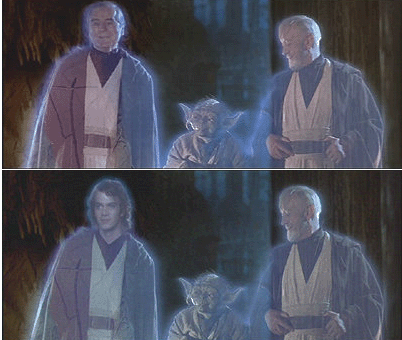
Not to mention that I’ve grown rather fond of George Lucas’s seemingly annual refreshes to the original trilogy every time there’s a rerelease on disc or on the big screen. You know – Greedo shoots first, Ghost Anakin is now Hayden, Vader cries “No!” It keeps the movies evergreen, as if they never really ended. Does this mean that the movies will now and forever remain frozen in carbonite?

I’m sure numerous fantasy crossovers have already sprouted up in the Twitterverse; personally, I’ve so far heard:

“Darth Sidious to join the cast of Once Upon a Time.” This is shameful in every conceivable way, and would considerably cheapen the Sidious brand. It would also put to rest any ambition that Once Upon a Time might have had of actually becoming its own brand, rather than just a clumsy mish-mash of Disney tropes.

“Darth Vader in Kingdom Hearts.” This could work. But would it be Vader, the thoroughly evil scourge of the galaxy, or the redemptive Vader at the climax of Return of the Jedi?

“Darth Vader princess outfits.” I don’t really understand this one.

Next thing you know, Ariel and King Triton will be visiting Boss Nass in Otoh Gunga, Herbie the Love Bug will be resurrected as a pod racer (Ocho Quadinaros?), and the Tomorrowland Terrace eatery will start serving Jango Fettucine with “Boba” tea.

My best crack at a crossover would see a Jar Jar Binks “plush toy” join forces with Buzz Lightyear and Woody in a space opera Toy Story 4. (Ahmed Best to reprise his voice and motion capture role.) In fact, with Buzz and Woody playing the roles of Qui-Gon Jinn and Obi-Wan Kenobi, respectively, I could see Pixar making a passable “Toy Story as Phantom Menace” hybrid remake. Meesa cannot wait!!!

Reports of an impending Episode VII, followed by new movies every few years (even after a “sequel trilogy” of VII-VIII-IX is complete) smack alarmingly of crass commercialism. And the press release begins ominously by announcing that this acquisition is all part of a grand Disney “strategy.”

But then again, maybe this has been a long time coming. After all, Star Tours opened at Disneyland in 1987, and these two titans have been friends (never rivals) for a long time. Moreover, being inundated by the products of these two companies in childhood actually inculcated in me all my lifelong values. I learned about chivalry from The Sword in the Stone, justice from Robin Hood, humility from Cinderella, honesty (and terror, though that’s more a feeling than a value) from Pinocchio, whimsy from Alice in Wonderland, compassion from Beauty and the Beast, friendship from The Fox and the Hound, and most importantly, I learned how to make a man out of me from Mulan.

From Star Wars, I learned the difference between good and bad, and that you always have a choice between the two.

And if nothing else, perhaps at least one dream comes closer to reality: Disney's California Adventure theme park can finally convert its Soarin' Over California ride into Strafing Over Hoth: When AT-ATs Attack. Yes, you want that.