Showing posts with label food and drink. Show all posts

Friday, March 15, 2013

My Life in 100 Anecdotes


I write slowly, I know it. But as I look back on the almost five years that I’ve had this blog, I am grateful that, slow as I was, I did write.

Today I close Czardoz Contra World with my 100th post. With this nice round number, it’s time to conclude this blog and start another (link pending).

I believe that lives are lived in anecdotes, not necessarily in days or years. And though it is tempting to think of “the best day,” a la City Slickers, I don’t remember full days, only moments. And that’s why I made my blog a collection of anecdotes about my life.

Over the years, there were many things I wanted to write about but never got to. Some articles were begun but never made it to the blog, usually because I couldn’t find out what I was trying to say, or because it took me so long to sort through my thoughts that they were no longer timely. Some articles got close but died for lack of some kind of relevance that would make them more than just self-indulgent words. Sometimes, I realized that I just didn’t have anything to say.

For this last post, I’ve included some anecdotes that mattered to me, and though I didn’t know then what to say, and may not know much better now, I found in each of them something about my life that I wanted to remember.

If I die tomorrow, I hope these items and the 99 posts that came before will be sufficient to explain who I was and what I valued.


*          *          *

February 2009: In Defense of Grimlock

I was luridly fascinated by the DVD audio commentary for Transformers: The Movie, perhaps because it matched the shambling mediocrity of the animated film itself. The hilarity began when director Nelson Shin started talking. He seemed to have only the barest command of English, and his comments, ranging from bemused to befuddled, had me doubting the level of control he had over the movie. He seemed only dimly aware of what was going on and why. Here’s Shin explaining a scene near the beginning of the movie where Unicron is shown sucking up a planet:

“Inside of the Unicron, this is organic, he gets the juice out and he’s getting lights [life], so he’s now the uh, he can survive, he can activate.”

Fun fact: Shin is now president of a Korean animation company that supplies animation work for numerous American shows, including The Simpsons. 


*          *          *

August 2012: How many guys does it take to throw away a perfectly good hamburger? (Answer: Five Guys!)

Regular readers of my blog will probably think that I eat fast food way too much. To that, allow me to emulate a charming Southern gentleman and say, “Guilty as charged!” (Yes, I know it’s a stale joke now, but trust me, this was a big deal back in August!)

In August, I went to a local Five Guys that I had been to a few times. Five Guys, to me, was the new kid on the block, an aggressive challenger from the East Coast that had made significant inroads in Southern California over the past few years. I think it had gained a sort of cult following based on complimentary all-you-can-grab peanuts in the store, messy burgers wrapped in foil, and that magazine article of Lebron James endorsing Five Guys that seems to be framed and posted in every store.

They make good burgers, and seem like sort of a more expensive cousin to In ‘N’ Out, bigger and sloppier, but with just as much hipster cred and everyman authenticity.

So on this occasion, I mistakenly grabbed someone else’s order, which I only realized when I had returned to my seat and peeked into the grease-stained bag. I brought the bag back to the counter and explained my folly. The server told me, “Oh, well we can’t take it back.” Fair enough. As a customer, I wouldn’t want to feel like I had to accept a plate of food that had previously been handed to someone else. She and the store manager exchanged some words to the effect of, “Make a new one for that customer, STAT!”

And then the three of us, the manager, the server, and I, we all just walked away, as if the bag contained a time bomb. I sat down and glanced somewhat uncomfortably at the bag of perfectly edible food that had been abandoned for the moment on that counter.

And here the questions began. Did they mean for me to take the bag, as a bonus, since they couldn’t? Were they going to retrieve it and maybe give the food to an employee later? Were they going to follow the most likely possibility and just throw it away? Should they have at least offered it to me? Or should I have said something, even though it seems sort of presumptuous to claim a free burger after my mistake had rendered it unservable to the rightful purchaser? What exactly was the right thing for me to have done?

Even though I told my brother as we sat there, “They’re just going to throw that away,” I somehow wasn’t prepared for the sight of the store manager chucking the entire bag right into a trash can not three feet away from me.

Even though I figured this was just store policy, and probably the policy of almost every restaurant you could name, I was dumbstruck. It was obscene. Children are still dying in Africa, aren’t they? I should hope so. Well, not “hope,” but I should think so.

When I was very young, there were often television commercials in the afternoon and evening for various outreach programs, asking for donations to help poor people in Africa and South America. You know the type, “just 48 cents a day will feed a child like Maria, and provide her with clothing, medicine, and a good education.” One time, according to my mother, I was watching one of these commercials, and I asked my mother, “Can we give them some food?” Apparently, I thought it was possible to just grab some delicacies from our refrigerator and pass them through the television screen to the rapturous enjoyment of these children. Or maybe I didn’t really believe that, but what I wanted was about as much a fantasy as that would have been. I wanted to help those other kids, and I thought that if I wanted it badly enough and spoke up about it, then every child in Africa would get three square meals a day, a pair of Nike sneakers, and a beautiful new schoolhouse.

Everyone had a good laugh over my naïveté and presumably we moved on with our lives. Hopefully those children in the developing world are moving on with theirs as well. The next time this happens, perhaps my choice is simple: I’ll speak up and say, “So can I keep this one, since it seems a shame for you to just throw away all this food?” I’d like to see them throw it in the garbage in front of me then.

And so, a noble burger was sacrificed so that I could learn a lesson, right? Not on your life. As soon as the manager’s head was turned, I reached into that trash can and nabbed that rudely discarded bag. And did I eat the food inside? Of course. And how was it? It tasted great. Like justice. 

*          *          *

August 2012: “a Tony Scott joint”

I wanted to add a few words to the funeral mound of observances of Tony Scott’s death, something different from the consensus in the media, which intoned, somewhat condescendingly, that we had lost an energetic maker of films that were critically unremarkable but commercially viable. I really don’t see why every critic had to chime in if they were all going to say the same thing. I guess keeping all these movie critics on staff saves the country’s unemployment figures from going even higher.

I never saw Tony Scott’s magnum opus, Top Gun, but I was a big fan of Man on Fire (which, along with Hide and Seek, had me convinced that Dakota Fanning was one of the very few child actors who could “bring it”). Undoubtedly, when you watch a lot of Scott’s films, you start to think they were all basically the same film, but the same criticism could be leveled at critical darling, Wes Anderson.

Scott’s movies had panache without the pretension. He managed to navigate a treacherous middle path between the Scylla and Charybdis of earnest self-seriousness and smirking irony. And with mild apologies to Spike Lee, I believe that if any filmmaker should have been using the word “joint” to describe his films, it was Tony Scott.

*          *          *

August 2012: The Bamiyan Buddhas

Around this time, I read a news item about the preservation status of the Bamiyan Buddhas of Afghanistan. Sadly, “preservation” is generous, as there hasn’t been much left to preserve since the giant Buddha statues (the largest two were some 53 meters and 35 meters tall, respectively) were dynamited into the afterlife by the Taliban regime in March 2001.

I first learned about the Bamiyan Buddhas when they made international news in 2001, as talk grew about the Taliban’s intent to destroy the statues, which had been crafted in the 6th century. I was affected by the notion that a work of art, though admittedly a work of religion in the eyes of those who hated it, could be treated so callously by a government. I thought to myself that any government, any people, who could do something like this would be capable of even more astonishing crimes against the living. 

Indeed, the Bamiyan Buddhas were close to my mind after the crimes of September 11, 2001. I’m not saying that 9/11 would have been averted if the “civilized” nations of the West had just bombed the hell out of Afghanistan and the Taliban, and saved these Buddhas early on. But no one should be surprised that these were the monsters who harbored Osama bin Laden. Destruction of artifacts, art, and cultural objects is perhaps the bellwether of genocide and murder. The Taliban were all too eager to destroy something that a competing culture held dear, if only because it was easier than hunting down every last person who still held those things dear.

I’m not a Buddhist, and I’m not sure I even know anyone who is a serious adherent to Buddhist ideas. But I recognize the value of religion and spirituality as an impetus for human creativity. No matter how strong one’s adherence to secularism, it would be hard to deny the glorious artistic achievements that were influenced, financed, or otherwise directly attributable to the existence and vehemence of religion.

No matter how technically impressive or aesthetically beautiful, I am aware that many monumental human artistic achievements, whether religious or secular or somewhere in between, were created by blood money and slave labor, and devoted to oppression in kind. After all, the Colosseum, so revered today, was but a temple to carnage and the institution of murder as entertainment. And as Thoreau said about that last remaining of the Seven Wonders of the Ancient World,


As for the Pyramids, there is nothing to wonder at in them so much as the fact that so many men could be found degraded enough to spend their lives constructing a tomb for some ambitious booby, whom it would have been wiser and manlier to have drowned in the Nile, and then given his body to the dogs.
– Thoreau, Walden

Nevertheless, the objects exist, and they represent a past and a people who can no longer represent themselves. As a humanist, I am appalled at any wanton destruction of the irreplaceable works of a past culture.

Today, I hear snippets of a similar rampage against art, culture, and human life in Mali. I know next to nothing about the ancient glories of Timbuktu and the present conditions of life in Mali. But I know that anything that can rile up fanatics so desperately that they go out of their way to destroy it is probably something worth saving. At the very least, the destruction of a statue or a manuscript or an entire library is a sign of worse things to come.

*          *          *

September 2012: To “pull a Goran”

When Andy Murray won the 2012 U.S. Open tennis tournament, I wondered if he had divested himself of the title of “best active player who hasn’t won a Slam” only to take on another dreaded title – was this Slam the first of many for him, or would it be the career highlight of a man destined to become a “one-Slam wonder”? Rather like Homer Simpson shedding the “stone of shame” only to be shackled to the even larger “stone of triumph.”

And much like Andy Roddick, whom I had lauded during his last, anticlimactic run at that same U.S. Open. In the journalistic aftermath of Roddick’s career-ender, I stumbled upon this informative slideshow of all the tennis players in the Open era who have won only a single Grand Slam tournament.

Looking at the names, I realize that it’s sort of a compliment when certain pundits cackle that Roddick underachieved or that he needs to have won more Slams to be considered among the greats. After all, do you think such a debate even comes up in reference to a Thomas Muster? Roddick wasn’t a fluke Slam winner, like Richard Krajicek or Anastasia Myskina. After his U.S. Open victory in 2003, he appeared in four more Slam finals over the next six years, and for some of those years, it was not outlandish to think he might win another big one. I doubt anyone looks at a Thomas Johansson and says, “What a disappointment. We expected a few more Slams from him.”

I think Roddick will be remembered very favorably alongside Michael Chang, a fellow American who won his Slam early, gave hope to every Chinese immigrant mother that her American-born son could become a big man in this country (okay, this part is not so similar to the Roddick career arc), then trailed behind the legends in his wake, all the while winning many lesser tournaments, keeping his nose clean, and contending well enough to make fans think a second major was probable, perhaps inevitable.

Roddick also calls to mind another player on the list: 2001 Wimbledon champion Goran Ivanisevic. I mentioned in a previous post that my favorite Slam final was the Federer-Roddick Wimbledon 2009, but Ivanisevic’s 2001 Wimbledon ride was just as memorable.

I remember it primarily because I was traveling in China at the time, riding down the Yangtze River on a cruise ship, watching Wimbledon on the tiny television in my room, because I was waylaid from some local disease brought on by a bug bite. With my head woozy and my hand swollen to roughly the size of an inflatable raft, I lay in bed watching tennis and listening to the lilting accents of a couple of announcers named Alan and Vijay who squandered no opportunities for hyperbole (“Too good!” “He’s playing like a shattered man!”).

Ivanisevic was a three-time Wimbledon finalist with a game tailor-made for grass, but he had never won, and though an eventual victory once seemed inevitable, by 2001 it seemed like his chances had passed him by. Having dropped in rank to 125th in the world and no longer considered an effective full-time contender, he only got into the tournament because he was granted a wild card. What he did with that wild card was unprecedented, winning the championship and giving his career a storybook capstone.

Wimbledon 2001 had no shortage of drama. It saw Justine Henin reach her first Grand Slam final, losing in three sets to Venus Williams. A 19-year-old Roger Federer upset defending champion Pete Sampras in the fourth round, a loss that more or less sent Sampras into a downward spiral into irrelevance until he finally emerged with a surprise victory in the U.S. Open 2002, after which he wisely retired.

This tournament was probably top British player and favorite son Tim Henman’s best chance at making a Wimbledon final, as he took a two sets to one lead over Ivanisevic in the seminfinal. However, rain delays turned the match into a three-day ordeal and seemed to wash away Henman’s rhythm and resolve; Poseidon had thrown his godly weight behind Ivanisevic.

Ivanisevic beat four Grand Slam winners on his way to the championship (though, like Goran, victims Carlos Moya and Andy Roddick are also one-Slam wonders, and Marat Safin and Patrick Rafter each won but two).

I remember watching Ivanisevic demolish Roddick, who at the time was a young gun known primarily for his cannon of a serve. Here he was, still quite green, and getting schooled by an over-the-hill wild card who simply fired ace after ace at him. It was a performance not just overpowering but distinctive, and I remember uttering “Roddick got Goran-ed!” for some reason.

Sadly, Roddick did not “pull a Goran” in his last tournament. I haven’t followed any tennis since the 2012 U.S. Open. The Australian Open just happened in January, and I couldn’t find it in me to care; I didn’t even look up highlights. First went team sports, and now perhaps even tennis holds no appeal for me any longer. 

*          *          *

November 2012: Fire the Critics

For a long time, I wanted to write a post about Pixar films, because they’re kind of a big deal, and for a long time, I held out because I didn’t think it was particularly useful, and indeed, it felt obnoxiously self-indulgent, to disparage any particular product or company just because I could. But there is something even more obnoxious about movie critics, as an industry, regarding their reviewing of Pixar films. This at least is worth a cursory dissection (vivisection? evisceration?).

A sampling of online reviews and editorials about Pixar and, primarily, their latest release, Brave:

“When it comes to Pixar, the worst is still so much better than most of the other junk being churned out by Hollywood.” (IGN)

“Still, Monsters, Inc. is fun and better than most of its non-Pixar peers (how many times do we have to make that distinction today?).” (IGN again – and to answer your question, you didn’t have to make that distinction at all)

“Arguably the worst of the best, the film [Brave] is simply decent (which ranks better than half the animated films released in a year).” (Screenpicks.com)

“If the Walt Disney Studios logo were the only one on Brave, this film's impeccable visuals and valiant heroine would be enough to call it a success. But Brave is also a Pixar Animation Studios film, and that means it has to answer to a higher standard.” (LA Times)

“Pixar’s own history of excellence has effectively painted the studio into a corner. If Brave were a straight-up Disney release, people would be hailing it, at the very least, as an end to the princess movie as we know it. Because it’s Pixar, they get to whine, ‘What? Princesses again?’” (Slate)

I’m quite tired of this blandly uncritical view that insists on starting with the premise that Pixar films must be judged by some rarified standard that eludes all other animation. If the role of the movie critics is merely to tell us that the gum that gets stuck to the soles of John Lasseter’s shoes is more beautiful than even the finest film that any other studio could produce, then really, what is the point of having the critics?

To praise Pixar’s track record is justified, but to go out of their way to defend the studio against any serious criticism is to undermine their own critical judgment. This seems to me a kind of moral cowardice, and moreover, it ignores the reality that other studios have started to make some very good movies that stand up well to what Pixar is dishing out.

To take one example, to my mind, Brave is not nearly as good as the Disney movie it most resembles – Tangled. For more examples, I’d rank Kung Fu Panda, How to Train Your Dragon, and Cloudy with a Chance of Meatballs alongside the best of what Pixar has made.

Richard Corliss’s Time magazine review of How to Train Your Dragon offers a historical perspective. While he acknowledges Pixar’s edge in box office, awards, and prestige, he has the audacity to compare the Pixar-DreamWorks rivalry to an animation rivalry of yore: Disney vs. Warner Brothers:

“‘Each year I do one DreamWorks project,’ actor Jack Black told the crowd at the 2009 [Oscars] ceremony, ‘then I take all the money to the Oscars and bet it on Pixar.’

That was also the case 60, 70 years ago, when Disney shorts had a monopoly on the Oscars, while the funnier, livelier cartoons from Warner Bros. – which today are treasured – were ignored. In that sense, Pixar’s features are closer to the old, elevated Disney style, while DreamWorks’s films are flat-out cartoons, proud to carry on the fast, cavorting Warner tradition.”

Not just DreamWorks, but Fox, Sony, and all the other companies that delve into animation have tended to shy away from the “elevated” epics that have become Pixar’s signature. This certainly feeds into the perception that Pixar makes “prestige” movies, while its competitors are making the animated equivalents of Michael Bay’s Transformers.

Moreover, we are meant to believe that animated movies by DreamWorks or Fox are churned out by wage slaves in a Korean factory (perhaps Nelson Shin's), whereas animated films by Pixar are willed into existence by an auteur, whose vision is rendered by a handful of artistic true believers. But whatever happens behind the scenes, the results don’t indicate such a strong ideological divide.

The Kung Fu Panda, Ice Age, and Madagascar franchises can be just as sentimental and (sigh) heartwarming as Pixar films, and Pixar’s movies are just as heavily laden with slapstick and low-brow comedy as their counterparts from the wrong side of the tracks.

My goal is not to heap scorn on Pixar for its well-earned success, but to argue that the divide between it and its competitors is narrow, and getting narrower. And though perceptions of Pixar’s superiority persist, especially in the critical community, these perceptions are not always supported by evidence. Pixar is the Apple of the film industry, and fittingly so, since it inherited its creative ethos from its founder, Steve Jobs. But that doesn’t mean that other companies aren’t making products that are just as intricate and enjoyable. 


*          *          *

January 2011: Grand Theft Auto IV

I basically inaugurated this blog with an anecdote about Grand Theft Auto III.  It seems fitting that I should end it with an anecdote about Grand Theft Auto IV. 

When I jumped back into Liberty City with GTA IV, I thought I’d get a few chuckles from driving over pedestrians, maybe roughing up some unwitting innocents in the street, and in the process find out if the Grand Theft Auto experiment had gotten more playable since my last foray into this urban wilderness.

The good news is that the addition of interior spaces, a speaking role for the player’s character, and “life” scenarios like going on dates with a girlfriend do enrich the feeling of “play.” The bad news is that driving is still an ordeal with no happy medium. Either you’re crawling slowly to grandmother’s house, or you’re zigzagging down straight roads and sideswiping pedestrians and lampposts with every turn. Shooting while aiming still requires a finesse I’ll never master. And committing random crimes will once again have the police hounding your ass very quickly, and you are never a match for their killing prowess.

Despite its flaws, I got a lot of enjoyment just from exploring the game’s possibilities, the many “what if” scenarios. What if I kill the bowling alley attendant? What if I kill the girl working at Burger Shot? What if I join the stripper on stage at the strip club? What if I run over some fools while driving Michelle home from our date? What if I kill someone on the street, wait for the ambulance to come, then kill the paramedic after he gets out of the ambulance – will another ambulance show up?

And on and on until I realized the irony of the GTA games: there is ultimately no liberty in Liberty City. In attempting to create the illusion of freedom and seamless immersion, the game ultimately draws attention to the limitations of its technology and all the restrictions imposed on the player. I can kill a hot dog vendor, but then I can’t take any of the hot dogs he was just selling? That don’t make no sense.

Nowhere is this more apparent than in the artificial boundaries imposed on the game map. As in previous games, you are stuck on one island in this fictional world, and only after meeting a set of achievements do you open up access to the next island. Funny thing is, there is a bridge to the neighboring island, and it exists the whole time you’re playing, but access to the bridge is blocked by concrete barriers and a fierce police presence, all under the guise of, I don’t know, construction or an investigation or martial law or some similarly ludicrous excuse. And yes, these coppers would unleash a lethal torrent of bullets if I stepped foot on that bridge.

Days passed. Days filled with the monotony of blowing off steam at the pool hall with my brother Roman. Going on dates to the bowling alley with Michelle and “trying my luck” when I took her home. Muscling low-level hoods and capping rival gangsters. And every day I’d drive by that bridge and those badge-wearing pigs and think to myself, “You don’t own me.”

What was on the other side? What was so important that they went to such extreme lengths to keep me from it? This was Shell Beach in Dark City. This was the painted sky at ocean’s end in The Truman Show.

There is a freedom out there, true freedom that exists without structures, and beyond artifice. The bubble world they created for me was not the world I wanted to live in, so I would make my own world, or die trying. “If man will strike, strike through the mask! How can the prisoner reach outside except by thrusting through the wall?”

I became convinced that if only I could get on the bridge and drive to the other side without getting shot to pieces, then that island would exist, just like the one where I was standing now. It would be real, with real people, and a real life. I just had to survive.

And so, I decided that, come heaven or hell, I would cross the bridge.

There was no sense in trying to drive through a concrete wall, so I knew my only chance was to run through the gaps in the barricade and steal a squad car that was already on the bridge. Once in, they couldn’t stop me. So I ran, taking heavy fire when the astonished goons realized I was actually going for it. Hot lead pierced any flesh that wasn’t covered in body armor, but I made it to the car, pulled the driver to the ground, and immediately I was flying!

Everywhere around me, I heard voices yelling, “Yes, yes! He made it! He can get through!”

The bridge felt like it went on forever. The first few hundred feet were breezy, with a few lights and sirens giving pathetic chase, but then the fuzz lowered the hammer. One after another, black police vans barreled head-on toward me at top speed on the threadlike bridge, trying to block me or crush me. They would take me dead or alive, so long as they ended my run.

But for the first time, my driving skills attained a sort of blissful elegance. It was as if I were controlling my car with my mind, not my hands and feet. Armored van on my left – I dodged right. Another van trying to squeeze me against the wall – I hit full throttle and drove past him straighter than I ever knew I could. I had attained automotive nirvana and eluded them all!

My supporters renewed the rallying cry, “Yes, yes! You did it! They can’t stop you!”

The bridge’s end drew into focus, with the massive skyscrapers of my destination coming into view. And then I saw the wall. There was never just one barricade. The police had a second one waiting for me this whole time, at this end of the bridge.

Every fiber of my being told me to stop the car and end this madness. But it was too late. This was my Thelma and Louise moment. At full speed, my speedometer about to crack from the strain, I slammed headlong into the concrete, the impact shooting my limp body through the windshield like a rocket, sailing past the front lines of cops and cars and landing like a broken doll tossed by a wailing infant. I had made it this far only to collapse under shattered glass and pitiless mortality.  

And yet my eyes opened!

I stand up, pat myself down, amazed. I had been shot, I had flown, I had crashed, and yet I live! And then I look about me and realize that I have crossed the bridge and am on the new island. It is real. And it is beautiful. I had made it. My dream was not in vain.

All I have to do now is grab the nearest police cruiser, as I had at the beginning of my escape, and drive. Always drive. And then I am free.

At least, that’s what I was thinking when my vision turned murky white, and my knees disappeared beneath me. I felt a warm moistness all over my chest, like I was bathing in salty water. And then the world went dark and I felt . . . nothing at all.

. . .

It was probably ten years ago that I played GTA III, but I still remember the Great Siege of Ammo-Nation. Ten years from now, when the many sordid misadventures of Niko Bellic in GTA IV have faded from memory, all we’ll remember is one glorious moment when I hurtled through a police barricade, jacked a squad car, and hightailed it across a facsimile Manhattan Bridge, crossing the Rubicon, making my own freedom.

*          *          *

Here we are at the Ides of March. As Caesar goes, so goes Czardoz, dying today, only to live forever . . .

Wednesday, August 29, 2012

I’ll have what he’s having, and make mine a double


So I was at McDonald’s the other day, and I notice sitting to my right is some old geezer eating a McDonald’s ice cream cone.

Good day to be an old guy, I thought.

Then, I notice that there is a second ice cream cone resting on his tray.

So I says to myself, does he have a grandkid scampering around here somewhere?

Old guy walks outside to get some sunshine, leaving the uneaten second cone. While he’s out there, I see that next to his tray is a 32 oz. Big Gulp from 7-Eleven, already drained, presumably down his gullet. While I’m considering the Big Gulp and noticing the distinct lack of children nearby, the elder statesman comes back inside, picks up the remaining ice cream cone, and starts to eat that too!

At this point, I’m wondering, have I entered the Twilight Zone? Who made him lord of the universe, that he gets to eat two ice cream cones in one sitting? After already downing a Big Gulp!

I am aghast. I don’t mean to judge, and I must admit that when I compare his plate to mine, he was traveling light:

My plate
McDouble – 390 calories
6 Chicken McNuggets – 280 calories
Honey Mustard Sauce – 60 calories
32 oz. Coca-Cola – 310 calories
Total = 1,040 calories (and it didn’t even seem like that much food!)

The Geezer Special
Ice Cream Cone – 170 calories
32 oz. Big Gulp – 310 calories (assuming Coke or Coke-like soda)
Total = 650 calories

He had some other edible item on his plate, but I don’t remember what, lost as I was in the haze of ice dreams. And that, much more so than caloric intake, is the point of this story.

I think I was just jealous that he had the stones to buy two ice creams, and here I was eating fast food and rationalizing it by choosing moderately priced and reasonably skinny protein-rich items. As far as the Coke, hey, it was a broiling hot day.

Maybe when I’m 95 years old, I thought, I can be like this old-timer. No. Three ice creams!

THE MORAL: It would have been leaner to have ordered two ice cream cones instead of a McDouble, and I could have congratulated myself on going veggie. 

Wednesday, August 22, 2012

The Greatest Play I’ve Ever Seen

Three and a half years ago, I started writing a blog post about the greatest play I had ever seen. But I kept putting the draft aside because I couldn’t figure out how to explain what made it special. I hadn’t yet “gone over the mountain,” as Thoreau would say. I’m still not sure I’ve gone over the mountain, but I’ll consider this a continued ascent as I shine my little lamp on a corner of the arts that has gotten scant attention on this blog: the theater.

It’s actually the silver screen that brings my attention back to plays today. As I flipped through articles about Tony Scott’s apparent suicide a few days ago, I came across other, lesser Hollywood news about Gary Ross, director of the sublime Pleasantville, now perhaps better known for directing the Katniss movie. It was announced that instead of helming the next Hunger Games movie, Ross’s next film project will be Disney’s Peter and the Starcatchers, based on the series of tween novels that were previously adapted into, yes, the greatest play I’ve ever seen.

*          *          *

A little background . . .

In my youth, I fancied myself clever for quipping that plays had been superseded by movies. My Shakespeare ardor morphed into a kind of revisionist fantasy as I pontificated to my fellow groundlings, “If Shakespeare were alive today, he’d be making movies, not plays.” I had seen engrossing, artful film adaptations of Shakespeare (Zeffirelli’s Romeo and Juliet, Branagh’s Othello, the Ethan Hawke Hamlet made some joy out of a play I never cottoned to), and if they were already pretty good, imagine what the Bard himself could have done.
                                                                                                            
It’s not that I don’t like plays. I can’t remember ever coming out of a play or a musical thinking ill of the experience. But I have many reasons for thinking that the movie is the superior form of thespian entertainment.

First of all, movies can do so much more than plays can. The combination of computer technology and a nearly unlimited range of physical spaces for shooting seems to shame the relatively limited stage into submission.

Beyond this, when you examine those shows that have both stage and screen versions, I’ve never known the screen version to suffer in comparison. Watching the stage adaptation of The Lion King, I was mildly amused at the mechanical masks that the principal actors wore, as well as the novel way that, say, a giraffe neck was integrated into a human actor’s costume. These are technical achievements to be sure, but there was nothing in the stage show that suggested that it had accomplished something the movie could not have, aside from a few gimmicks, like “animals” roaming down the audience aisles (and perhaps The Lion King 3D rerelease successfully challenges this advantage). The difference was costuming versus animation; otherwise, the show played out just like the movie, and ended up feeling unnecessary.

To go the other direction, when The Phantom of the Opera was adapted into a film in 2004, under the guidance and production of Andrew Lloyd Webber himself, the look was beautiful and the music just as thrilling, but if anything, you could say that the filmmakers didn’t do as much with the technology as they could have. As with The Lion King, the two versions just looked a little different, but it’s the movie versions that would seem to have more potential. The Lion King on stage looked like a static version of the film. Phantom, having originated in a more static medium, felt a bit uncomfortable on the screen, if only because we are accustomed to seeing constant, sweeping movement on a movie screen.

I’ve already mentioned Shakespeare, but even looking at the plays in themselves, I have rarely felt that the staging and performance were necessary. I’m sure I’m not the only person who gets more out of reading the plays than seeing them live. The most necessary Shakespeare production I’ve seen was Two Gentlemen of Verona at the Chicago Shakespeare Theater, and that’s because it was set in the 1920s and had an original ragtime piano score and songs. It seemed to make more out of the source material, and thus made it worth putting down the book and buying a ticket.

And that brings me to another crucial reason for preferring the cinema. Given the bourgeois nature of the stage versus the more democratic playing field of a movie theater, it’s hard to sympathize with what the dramatists are peddling. I just paid $20 to see The Dark Knight Rises on the IMAX, and I considered this a gross extravagance. Until I reminded myself that $20 would not have gotten me a seat of any kind at most of the playhouses in town. And no, most theaters don’t actually welcome groundlings.

At the Las Vegas production of Phantom at The Venetian, the overture is accompanied by a fine special effect that you couldn’t experience in any movie – the epic vision of a gargantuan chandelier above the audience, breaking apart and swaying with spectral malice above our heads. Neat trick, I thought. But then when I considered that I had paid $85 to watch a giant chandelier sway about, I didn’t think it was so neat anymore.

One of my local multiplexes is at a shopping mall next to Ruby’s Diner, which is a mid-range hamburger chain that offers movie ticket discounts if you show your dinner receipt at the theater. Now, I never heard of anyone offering discounted tickets to see Desire Under the Elms with the purchase of a hamburger. And for that matter, isn’t it strange that it’s virtually mandatory to treat your date to some kind of swanky Waldorf salad and duck confit bistro for dinner before heading to a performance of Hedda Gabbler, even though all you can afford after buying the tickets is McDonald’s?

The difference between plays and movies is the difference between theaters that are named after some hoity-toity personality (Goodman, Ethel Barrymore, Brooks Atkinson), and theaters that are named after the number (and sometimes size) of their screens (AMC 20, Edwards 18 IMAX).

It’s the difference between “theatre” and “theater.” 

*          *          *

So much for plays, then. After all, what could possibly redeem this bastion of privilege and obsolescence?

In February 2009, the La Jolla Playhouse premiered Peter and the Starcatchers, a play written by Rick Elice, and directed by Alex Timbers and Roger Rees (yes, that British guy with the recurring role on Cheers, and a small role in The Prestige). It was adapted from the series of novels written by Dave Barry, the humorist, and Ridley Pearson, and published by a Disney subsidiary firm. The story is billed as a prequel to J. M. Barrie’s Peter Pan, which was originally a play before Barrie himself turned it into a novel called Peter and Wendy, and before Disney rendered it as its fourteenth “animated classic” in 1953.


Three years later, I don’t remember many of the details or plot points (another black mark against plays – where’s the commemorative DVD?), but I do recall being impressed at how Peter and the Starcatchers succeeds as creation myth behind the already well-known Peter Pan myth. We learn how Captain Hook (or the Black Stache, as he is known) lost his hand. We watch as Tinker Bell comes into being. We see Peter earn his “Pan,” and are treated to one interpretation of the name.

But what I remember most was what took the play beyond the boundaries of any movie – the conceit of having the actors play not just characters, but also props and sound effects. The most memorable special effect was the simplest and most frequent – the actors would transition seamlessly from playing orphan boys and pirates to playing doors. One actor would literally swing another actor open as though he were a door.

This and other flourishes, such as having actors play parts of a ship, or becoming a chorus of dripping water sounds, relied on the sharpest acting, and the cast was more than capable. The effect was somehow elegant and rustic at the same time, like the rude mechanicals from A Midsummer Night’s Dream, or perhaps something like Cirque du Soleil as performed by Monty Python.

This effect, actors playing props, is not unprecedented, but the execution was so smooth and realistic that it erased the barriers between actors and objects. It also created an exciting fluidity and enforced the expectation that anything could happen, any actor could potentially be anything on stage at any time, so there was no waiting for the lights to go down so that black-shirted stagehands could rush in and whisk away a table and bring in a park bench or something.

The play successfully erases the barrier that I’ve always felt existed between the stage and the audience, so that nothing compromises the illusion of being in Peter’s world.

*          *          *

Writing about the play now feels like being in that scene in The Prestige, when Hugh Jackman watches Christian Bale perform The Transported Man for the first time. The magic trick isn’t even shown on screen, but you see Jackman’s reaction and the life-long obsession it engenders in him – “the greatest magic trick I’ve ever seen.” Likewise, you may feel like my story is missing something, namely – the trick. Can no-tech effects and virtuosic acting really explain what happened on that stage that enraptured me and separated it from other plays? Wasn’t it just more expensive gimmickry?

It may seem counterintuitive, but for me, movies have a monopoly on verisimilitude. Immersion is more natural at the movies; I feel like the movie is really happening in the moment, whereas plays seem, frankly, as staged as the moon landing.

Peter and the Starcatchers was the first time I ever went to a play and forgot for a moment that it was a stage. It’s as if they invited me in, told me that the story was to be a simple one that I had heard before, told me the stage was just wood and steel, and yet when they started performing, they still somehow got me to believe in it. Transforming the inherent fakeness of the stage into something real is the magic – the kind that every play aspires to conjure, but which I had heretofore found almost exclusively in the movies.

Indeed, the play has much of the vaunted Disney magic that seems increasingly rare in Disney’s animated pictures these days. (And please don’t bring up Pixar. Their movies are enjoyable, but Pixar specializes in high craftsmanship and cleverness, not magic – floating house notwithstanding.)

Though I’ve experienced more capacity for transport in the movies than in plays, it doesn’t mean that it happens often. But high-concept magic guided the modernized morality of Gary Ross’s Pleasantville, and Ross also wrote the screenplay for Big, the seminal magic movie for boys growing up in the 1980s, so perhaps he and his team can summon some of that classic magic for Peter and the Starcatchers as well.

*          *          *

My experience with Peter and the Starcatchers doesn’t change my belief that movies can do so many things that the stage just can’t. But at the same time, the stage is capable of things that movies wouldn’t dare to attempt.

But having said that, there is one final damning trait exhibited by even the finest play; in fact, it is especially the finest plays that are most beleaguered by this trait.

The greatest play I’ve ever seen is one that you will never see, unless you and I attended the same show.  I’m being a bit dramatic, for even if we attended different performances, you probably saw more or less what I saw. But as the production moves from place to place, as the cast gets jiggered, and the staging is updated, and sets reconstructed, and lines rewritten, and concepts reconceived, and even the title tweaked (by the time it hit Broadway and started winning Tony Awards, it was called Peter and the Starcatcher), eventually, though you may see the play, it will be a different experience. 

And I think it’s this unbearably ephemeral nature of a great play that tears me up inside and makes me want to do away with the theater entirely.

I am reminded of these lines in Carl Sandburg’s poem, “Languages”:
Sing – and singing – remember
Your song dies and changes
And is not here to-morrow
Any more than the wind
Blowing ten thousand years ago.
*          *          *

So I ask myself that question now: what would Shakespeare do today, plays or movies? I’m not sure. Maybe a little of each. But surely, what with juggling both stage and screen, he wouldn’t bother writing sonnets. Right? 

Tuesday, July 31, 2012

A Game of Chicken


You have surely heard that the Chick-fil-A chain of chicken sandwich restaurants has been taking a beating lately in the liberal media for the proudly unambiguous anti-gay statements made by its president, Dan Cathy, which he has backed up with significant financial contributions to gay-unfriendly organizations. Considering that he runs an empire founded on poultry, perhaps one is not surprised at his willingness to ruffle some feathers.

Just before the flap began, I happened to go to a Chick-fil-A for one of their breaded chicken sandwiches. I first tried their food a few years ago, and thought they offered a flavorful sandwich at a reasonable price, and most notably, in a very clean and friendly environment. I was, however, taken aback by an odd marketing and signage campaign featuring cows foisting deliberately misspelled slogans in a particularly heinous font. Imperatives such as “Eat mor chikin” and a special promotion, “Dress like me, git free chikin,” acquired a decidedly ominous, even fascistic glower, which didn’t seem in keeping with the chain’s otherwise homey aesthetic. Upon further thought, this perhaps is meant to evoke the quaint rusticity of the chain’s Southern roots, or else leaves open some speculation about fundamentalist Christianity’s anti-intellectual tendencies.

The sun's rays are oddly reminiscent of iconography from WWII-era Imperialist Japan.

At my latest visit, the service was once again pointedly friendly. The teenaged girl who took my order flashed a brilliant smile full of braces, certainly more welcoming than the usual McDonald’s employee, who tends to have the disgruntled visage of one of Bane’s henchmen in The Dark Knight Rises. A woman who appeared to be the store manager walked out from behind the counter to bring me my takeout order, and asked if I wanted their “special Chick-fil-A sauce” with it. 

After the bad press began, I wondered, would the service have been any worse had I ordered my sandwich while sporting a rainbow flag t-shirt, or if I had tried to regale the staff with tales of my ribald shenanigans at the local Pride Parade (which happened to take place just as this henhouse kerfuffle began). On the flip side, how should I go about treating them, now that their company-sanctioned bigotry has become newsworthy?

Boycotting Chick-fil-A, that is, making a stand with your wallet, is undoubtedly good for your conscience, your finances, and your waistline – a win-win-win situation. But I wonder if it’s any kind of solution at all, in light of all the other institutions and corporations that so deftly dodge the rather narrow purview of our consciences.
                                                                                                            
Civil rights offenses are a favorite whipping boy of the media, and furthermore, they seem to penetrate down to the sensitive emotional core of the populace, laying waste to more family dinners and love affairs than comparatively benign topics such as abuses of human rights (Chinese workers slaving away to make Apple products) or the ravages of economic inequality and immobility (working for minimum wage at McDonald’s/Target/Wal-Mart/etc.). Beyond mere rights and privileges, I’m sure there are a whole host of other evils associated with just these few companies I’ve mentioned, ranging from environmental to political and so forth. But not a lot of people (gays included) get indignant enough to throw away their iPhones or stop shopping at Target (itself a company with a history of both angering the LGBT community and seemingly pandering to its purchasing power).

No person can stand up for every good cause, nor should he be expected to. But every “Chick-fil-A moment” seems to me a signal, a cock crow (if you’ll indulge the pun), to align one’s life along the trajectory of justice.
                                   
I am reminded of Henry David Thoreau, who wrote:

It is not a man’s duty, as a matter of course, to devote himself to the eradication of any, even the most enormous wrong; he may still properly have other concerns to engage him; but it is his duty, at least, to wash his hands of it, and, if he gives it no thought longer, not to give it practically his support. If I devote myself to other pursuits and contemplations, I must first see, at least, that I do not pursue them sitting upon another man’s shoulders.
- Resistance to Civil Government, aka Civil Disobedience

There is a game of chicken afoot, but it’s not a game played against a corporation or a bigot or even a socioeconomic paradigm that fosters such strife and selfishness; rather, it’s a game you play with yourself. You test yourself against your willingness to engage in activity that is unworthy of you. Let us see which is the stronger. 

Wednesday, November 30, 2011

The Gateway City

For being such a well-known place and such an old city (by American standards), St. Louis is actually a relatively small city.  St. Louis is home to Anheuser-Busch of Budweiser fame; it hosted, in the same year, a World’s Fair and an Olympic Games (1904 – the first Olympics in the United States); the Cardinals are a storied baseball team.  Most of us are familiar with Charles Lindbergh’s Spirit of St. Louis and the film Meet Me in St. Louis.  St. Louis has most of the things that seem to characterize a cosmopolitan city: museums, trendy restaurants, nightlife, a large urban park, a symphony orchestra, a passable light rail system, an international airport, a well regarded research university, three major sports teams, and at least one iconic feature: the Gateway Arch.  Yet as I drove around town on a recent visit, seeing various neighborhoods, and trying to figure out what made this place special, it was hard to escape the feeling that there wasn’t much going on.  It felt like a smaller version of a city like Chicago, or even San Diego.  It was sort of a Portland of the Midwest, though less hipsterific.  But it’s hard to distinguish yourself by being a smaller version of something else.  As Emerson wrote in the Divinity School Address,

Imitation cannot go above its model.  The imitator dooms himself to hopeless mediocrity.  The inventor did it, because it was natural to him, and so in him it has a charm.  In the imitator, something else is natural, and he bereaves himself of his own beauty, to come short of another man’s.

*          *          *

Gateway Arch, designed by Eero Saarinen.  The one thing everyone knows about St. Louis, this symbol is ubiquitous in the city, found in souvenir photos and knickknacks, integrated into logos, and even used as a replacement for the “N” in some signs.
   
A placid scene from the Occupy St. Louis presence downtown, in the shadow of the Arch and the Old Courthouse.

Washington Avenue with the lights on.  The locus of nightlife downtown.

The original office building at the Anheuser-Busch brewery.  I’ll never forget the smell that saturated the air around the complex, richly earthy and almost appetizing.  Malted barley, maybe?  Yeast?  I don’t know, but I like it.

Inside the City Museum, something like a funhouse crossed with a wrecking yard, but nothing like a museum.

Rue Lafayette, a café cum antiques and vintage goods store.  Note the A. E. Housman poem, “With Rue My Heart is Laden,” framed.  Is there a pun there?

What we know as Panera Bread actually started in St. Louis under a more local moniker.  (No, I didn’t go inside for a snack, although on my first visit to St. Louis, some seven years ago, I did go to this very one, and thought, "This food is good.  They should really expand nationally."  I guess they went with that.)

I found religion when I tried the gooey butter cake, one of the triumvirate of uniquely St. Louis delicacies (the other two being toasted ravioli and St. Louis-style pizza).  It tasted like a moist brownie, but not chocolate.  Or something like the widely available raspberry bars or toffee almond bars, but . . . gooey-er.  Like manna, my friends.  I'm talkin' Old Testament.

Toasted ravioli.  I felt very much that this is the right way to prepare ravioli.  I don’t dislike your typical boiled ravioli with sauce, but I don’t think I’ve ever thought to myself, “I really have a hankering for some ravioli today!”  And I’ve always thought it kind of silly when upscale restaurants have some version of ravioli on the entrée menu, whether something exotic like rabbit or elk (no matter how outlandish the animal, you never get any discernable flavor from the ground meat paste that goes inside the dough), or a token vegetarian option.  But when I tried the toasted ravioli, I thought, “Yes, this is something I could find myself craving.”  Perhaps, alongside the Arch, the home-grown cuisine can truly be considered the pride of St. Louis.

*          *          *

St. Louis compares favorably with another medium-sized Midwestern city I’ve visited: Cleveland.  That probably doesn’t sound like a recommendation, but both of these cities have beauty to find, and I’ve enjoyed my chances to visit less obviously enchanting places.  When you go to New York, if you’re a certain sort of savvy traveler, you try to look for “off the beaten path” attractions and “neighborhood joints,” and you marvel at your good luck and ingenuity when you capture a taste of what the “locals” do, as opposed to getting mired in tourist traps.  But when you visit a place like St. Louis, it’s pretty much all “off the beaten path,” and it allows you to appreciate discovering a place without the mist of preconception between you and it. 

My only regret upon leaving the Gateway City was that I didn’t try the St. Louis-style pizza, which is distinguished by the thin and crispy crust and the trademarked Provel cheese, a kind of processed cheese that I have heard will “stick to your mouth” and is “kind of gross.”  Apparently, this oddity can only be found in St. Louis and the environs, and the locals seem to either love it or hate it.  Maybe some even love to hate it, which is as strong a recommendation as I can think of for trying it. 
              
Next time, St. Lou.  Next time . . .

Sunday, July 31, 2011

Seed of doubt, kernel of truth

As a sequel to my previous post, “Curse all seeds!” I’m happy to report that the Slate Explainer has answered “a version” of my seedless watermelon question . . . here. My thanks to the Explainer!

For reference, my original question was: Why does so-called seedless watermelon have seeds? Specifically, the little white “seedlets.”

The Explainer only answers my question directly in the Bonus Explainer at the end of the article, and then only briefly, but I won’t fault them for that. It’s kind of a thrill to get a published response at all, and they offer a detailed answer to the question they are more interested in: what is the difference between seed types/colors in watermelons?

Regrettably, I have never specifically wondered about the difference between white seeds and black seeds in a “regular” watermelon. So for me, the entertainment value of this question is about on the level of, say, how common is premarital sex at BYU? Or, what is the congressional gym like?

I was more interested in the socio-economic ramifications of what I considered a biological oddity.* People buy seedless fruit for the perceived masticatory convenience. So why market an item as “seedless” when it has some seed-like elements, even if they are only “hard seed coats”? Honestly, does it make much difference to my mouth whether I have to spit out mature seeds or empty seed coats?

I’ve been told, “why don’t you just swallow them?” Well, that’s not really the point, is it? For people who don’t care either way, it’s easy to recommend a “grin and bear it” mentality. And if I were some soft, dandyish type who was born with a silver ladle up my petard, accustomed to suckling on the teat of an overfed nursemaid, I could see this as a valid point. But I’m not bemoaning a world that allows people to be victimized by the arduous chore of watermelon-eating. I’m just annoyed by the lack of clarity, consistency, transparency, whatever you want to call it.

Maybe I’m the only one who’s bothered by it. And I admit that my intellectual curiosity about this far outstrips my gustatory qualms about seedless watermelon.

But no, I’m still not swallowing.
_______

* I’ve also enjoyed reading about the genetics behind growing a seedless watermelon, which is the triploid (three sets of chromosomes) hybrid of a diploid plant and a tetraploid plant.

Friday, July 29, 2011

Curse all seeds!

Dear Slate Explainer,

I’ve been enjoying my fair share of watermelon during this hot summer. Perhaps to the dismay of the watermelon seed spitting champs of Luling, Texas (as well as greenhorn porch-swingers and curb jockeys all over the South), I always buy seedless watermelon. However, it has always bothered me that there are all those little white seeds or “seedlets” in there, as well as the occasional “normal” black seed.

Why does so-called seedless watermelon have seeds? Seedless oranges and grapes generally have no seeds whatsoever. I buy seedless fruit because I don’t have the patience for the oral gymnastics of sifting through seeds. What gives?

Thanks.

Czardoz Contra World

* * *

A few days ago, I emailed a version of the above to the Slate Explainer, a column that answers questions “about today’s news.” Not directly factual questions about specific events, which would be boring, but rather, thematically germane questions, the kinds of quandaries that particular events get you thinking about. So you would likely find a question about choreographing fireworks displays during the Fourth of July, or a question about lethal doses of radiation during the Fukushima nuclear tragedy in Japan, or even a question about the various spellings of Gadhafi (Qaddafi?) during the apex of Libyan revolution coverage.

I especially enjoy questions that address cultural touchstones, things that everyone has some experience with, for example: what happens if you eat the silica gel that’s packed in with your ramen packages and Blu-ray players? And I can’t help reveling in questions with some lurid fascination, like: would your dog eat your dead body? Or, what does whale taste like?

So, do you think they’ll answer my question on the website? I hope so, because I certainly think it has more entertainment value and intellectual breadth than, say, whether someone can really make you go to rehab, or how the NFL’s collective bargaining agreement compares to that in the other major sports.

Is it petty of me to say that I am terminally annoyed with the white seedlets in seedless watermelon, from both mouthfeel and nomenclatural standpoints? The former point is obvious; the latter, well, in a marketplace that has established the meaning of “seedless” to mean “without seeds” for other fruits, isn’t it somewhat fraudulent for the watermelon to gallivant through the produce section under the same banner? Wouldn’t it be more honest to call it a “white seed” watermelon as opposed to a “normal” or “black seed” watermelon? Actually, who’s to say what’s normal? I wasn’t aware until researching this issue that the familiar yellow Cavendish banana is actually a “seedless” fruit, produced through vegetative reproduction rather than sexual reproduction. They seem pretty normal to me!

In an era where the bioengineering of food is commonplace, where inaccurate and misleading labels are as old as Rhode Island and the Indians of Christopher Columbus, and where getting a raw deal is considered business as usual, perhaps we’ve lost our innocence on numerous fronts. It’s a loss I can bear, but in the absence of innocence, I should like very much to retain my sense of outrage.

* * *

UPDATE!

During the course of writing this post, I received an email response from Daniel Engber, Explainer editor, who told me that they “might answer some version of it tomorrow.” Cross your fingers!

Friday, July 30, 2010

All about the Bertos

I’ve heard it said that San Diego is a one-horse town. But then the Clippers left, so what are we now?

Now there’s this insidious talk that Comic-Con might be fleeing town for Anaheim or LA or even Vegas. If that happens, well, what is there to do but cry "havoc" and let slip the dogs of war?

At least we’ll always have the taco shops. You’ve probably heard of Roberto’s, the flagship and, apparently, the progenitor of what are known as “the Bertos.” There’s also a longstanding chain called Alberto’s that reportedly was started by the same empire that Roberto’s wrought.

If the saga had ended with these two siblings, this latter day Romulus and Remus, I’m sure the late night enchilada and weekend menudo scene would have still thrived, to the consternation of many a local aorta. However, like Sherman marching through the South, they had scorched a path for many an ambitious imitator to follow, and pretty soon, every Tom, Dick, and Hidalgo was opening a taco shack in the Bertos mold.

And so, in honor of my no-horse hometown and also my beloved Fred (played by Amy Acker) from the TV show Angel, whose love of taco shops is well-documented (albeit Los Angeles joints), I present a family portrait of local Bertos, bastards front and center.

Roberto’s
Kearny Mesa


Here it is, the grandpappy of them all. Rubio’s, eat your heart out! (Seriously, though, this food is not good for you.)

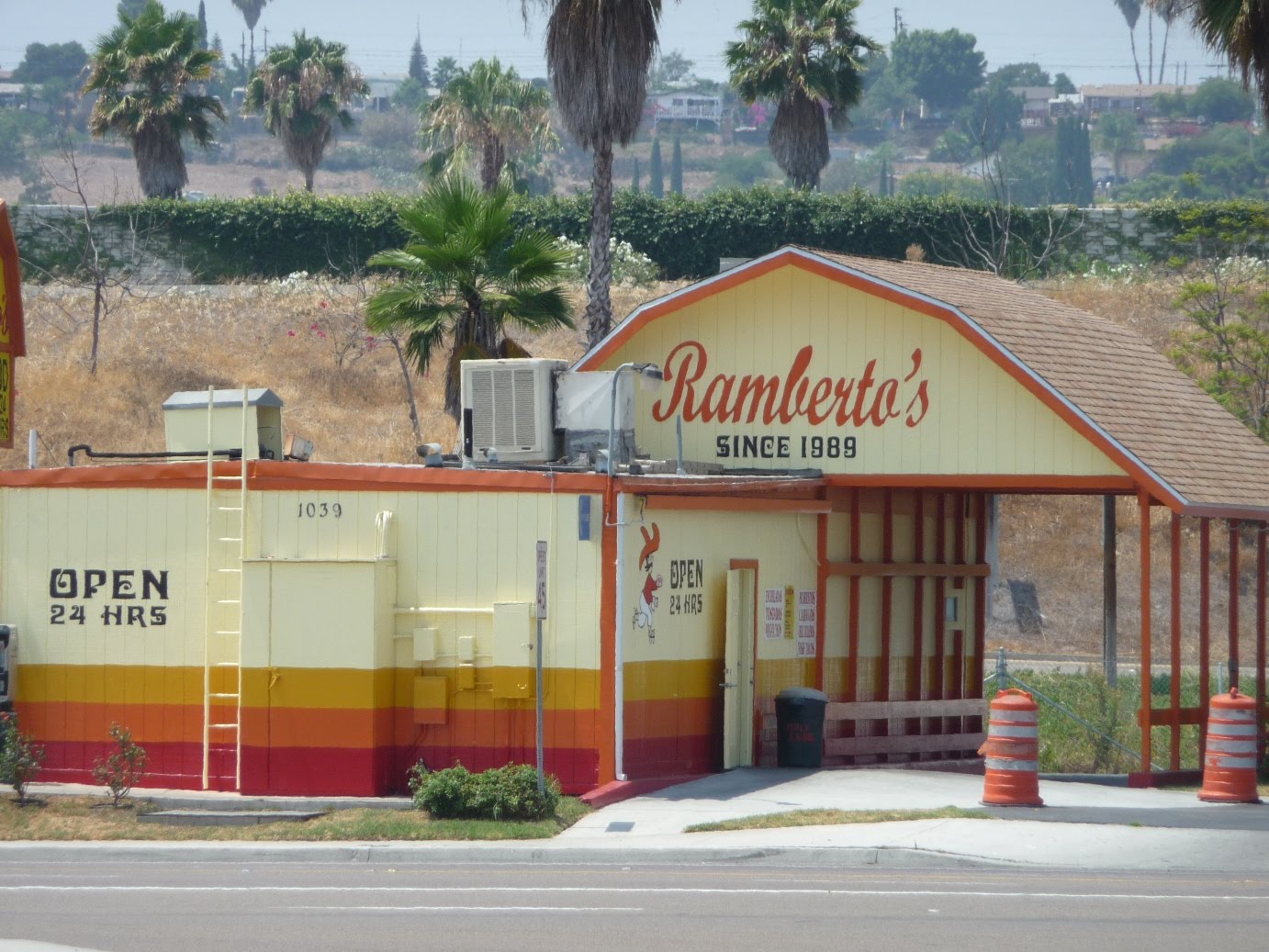
Ramberto’s
Spring Valley


This particularly violent contender has been ramming burritos down your throat since 1989.

Filiberto’s
Encinitas


It is said that Filiberto’s is far inferior to the taco shop next door, known by the sexy name of Raul’s. To which I say, “No duh. One is a Berto’s, and the other is a Raul’s.”

Eriberto’s
Oceanside


This place is pretty depressing to look at, even by Bertos standards.

Rigoberto’s
North Park


The sign says it all: “The best Mexican food in town.” Rigo, I hoped you’re a damned liar, because if 5 rolled tacos with guac constitutes the best Mex this city has to offer, then we’re in worse shape than I thought.

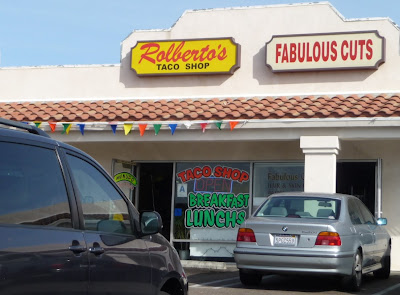
Rolberto’s
Spring Valley


This I don’t get. There’s already a Roberto’s (about a million of them, actually). What on earth is Rolberto’s? To their credit, they offer breakfast and lunchs.

Adalberto’s
Sherman Heights


Again, I’m confused. The name "Adalbert" has Germanic origins, and apparently, there was a St. Adalbert of Prague, but what German person evens wants this obscure name? So how is it that a completely separate culture would want it?

Gualberto’s
Kearny Mesa


Huh? Robert is a name. Albert is a name. Even Adalbert is a name. But what’s Gualbert?

Humberto’s
Golden Hill


Nabokov, a noted chimichanga fan, would be proud. Nymphets, coquettes, and assorted pre-adolescents, stay far away!

Robertaco’s
San Ysidro


One last entry. This is not an official Berto’s, but I’ve included it for sentimental reasons.

Notes

1. This is not a comprehensive list; for something like that, see here.

2. Though I took all of the accompanying photos, I did not make any special trips to get them. Such is the ubiquity of the Bertos name that I was able to get all of these pictures while in the course of other pursuits.

3. In case anyone is wondering, no, heavens no, I haven’t eaten at any of these establishments. I should note, however, that once, after having a glass of wine with a young lady, she informed me that we had strolled over to Humberto’s, and I had behaved boorishly toward some hipster lad. I immediately declared that I had no memory of any such interaction, and to this day, I deny everything.